60% First-Contact Resolution Is Not “Okay.” It Is a Cost Multiplier
A GZP Reality Check
When four out of ten customers come back, every queue, handoff, and exception gets more expensive.
TL;DR
- 60% FCR means 40% of issues are still open after the first contact, which creates repeat volume that stacks on itself.
- Repeat contacts are not neutral. They raise cost per resolution, extend queues, and increase escalation load.
- The biggest drivers are usually outside the agent. Policy friction, tool limits, missing authority, and weak handoffs show up again and again.
- Fix the definition and measurement before the coaching blitz. Bad measurement sends teams after the wrong root cause.
- Treat 60% like an incident. A focused 30-day plan can move FCR when it targets the top repeat drivers and assigns clear owners.
Make 60% FCR feel as urgent as a revenue miss
First-contact resolution sounds like a support measure. It often sits next to handle time and schedule adherence. That placement makes it feel like an internal topic. At 60%, it is not internal. It is a business control that is slipping.
At 60% FCR, four out of ten customers end the first interaction without a real finish line. Some are told to wait. Some are routed to another team. Some are asked to try again later. Many comply, then come back. Some do not come back and still stay unhappy. The demand does not go away. It returns in new shapes and new channels.
That is where the compounding begins. The second contact is rarely the same as the first. It comes with more frustration, less patience, and less trust. It runs longer. It escalates faster. It creates more exceptions. It drags in supervisors, specialists, and back-office teams. It also increases the odds of credits, fee waivers, or replacements that could have been avoided.
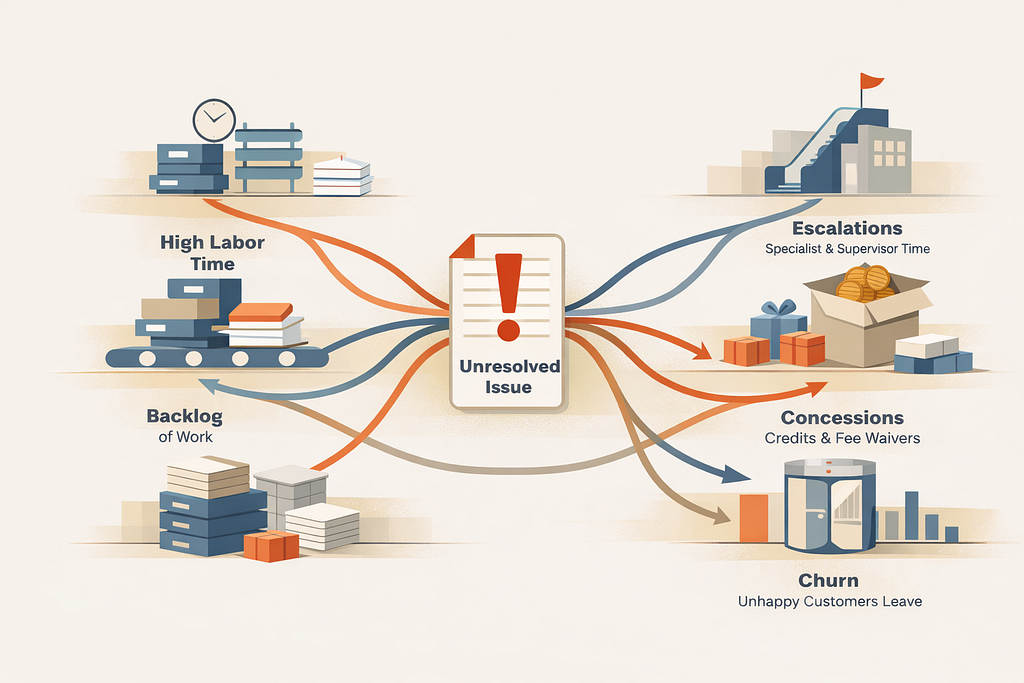
The quiet part is that the cost rarely shows up as a single line item. It spreads across labor, backlog, churn, write-offs, and product defects that stay unfixed. Leaders feel it as a constant shortfall. The center “needs more people,” service levels “keep slipping,” and customers “keep complaining.” The instinct is to push harder on the frontline. That tends to raise stress and attrition, and it rarely fixes the underlying drivers.
Our research across multiple service programs shows a practical benchmark: strong operations tend to live well above 60% for the work that is meant to be resolved on the first contact. Not every issue can be closed in one interaction, and that is fine. The emergency is that too much work that should close is not closing.
A useful way to frame it: 60% FCR means the operation is paying for the same problems more than once. When the same problems repeat, the rest of the system bends around the repeat work. That bend is what turns a metric into an emergency.
See the compounding in plain math, not in slogans
The easiest way to get alignment is to stop talking about contacts and start talking about completed resolutions.
Contacts are what arrives. Resolutions are what closes. A center can look stable on contacts and still fall behind on resolutions.
A simple model makes the point without drama.
Assume 100,000 inbound contacts in a month. If FCR is 60%, around 60,000 issues close on the first interaction. That leaves 40,000 issues still open.
Those 40,000 are not just “not resolved.” They are future demand waiting to happen.
Not all customers come back, but enough do to bend the month that follows. Even if half of those open issues return, that is 20,000 extra contacts created by the prior month’s misses. Then add the fact that repeat contacts cluster in the hardest topics. The hardest topics already take the most time and the most judgment. That clustering raises average handle time. It also pulls more cases into escalation paths.
Now add a second layer: customer behavior changes after a miss. Our research commonly sees satisfaction drop on repeat contacts. The drop varies by industry and severity, but the direction is consistent. A customer who has already tried once is less willing to wait, less willing to accept a policy answer, and more likely to demand a supervisor or a concession.
So the repeat contact is not just a multiplier on volume. It is a multiplier on complexity.
This is the compounding cost: the system gets more work, and the work gets harder. That combination will outpace staffing plans even when hiring is strong.
Put the hidden P&L behind FCR on one page
Low FCR is expensive in ways that do not show up in a single report. Finance may see higher cost per contact. Product may see higher return rates. Sales may see higher churn. Operations may see higher backlog. Each team sees a slice and none sees the full stack.
Here is where the money usually hides.
Labor cost rises in the worst way
When volume rises from repeat work, headcount follows. But headcount does not buy progress if the work is the same issues arriving again. It buys the ability to keep up with yesterday’s misses. That is why teams add people and still miss service targets.
Cost per resolution rises even if cost per contact looks stable.
Many reporting stacks are built around cost per contact. That is a useful metric, but it is incomplete. Customers do not buy contacts. Customers buy outcomes. When FCR drops, contacts per resolved issue rises. That is the metric that maps to margin.
Escalations consume the most expensive time.
Second and third contacts escalate more often. They also attract the cases with the most ambiguity. Supervisors and specialists then spend time on work that should have been simple, but became complicated through delay and rework.
Credits and waivers become the pressure valve.
When queues are long and customers are upset, concessions rise. Sometimes that is the right call. Often it is a way to end the interaction. Over time, the concession budget becomes a shadow policy, applied unevenly and driven by who complains the loudest.
Back-office work grows without being staffed.
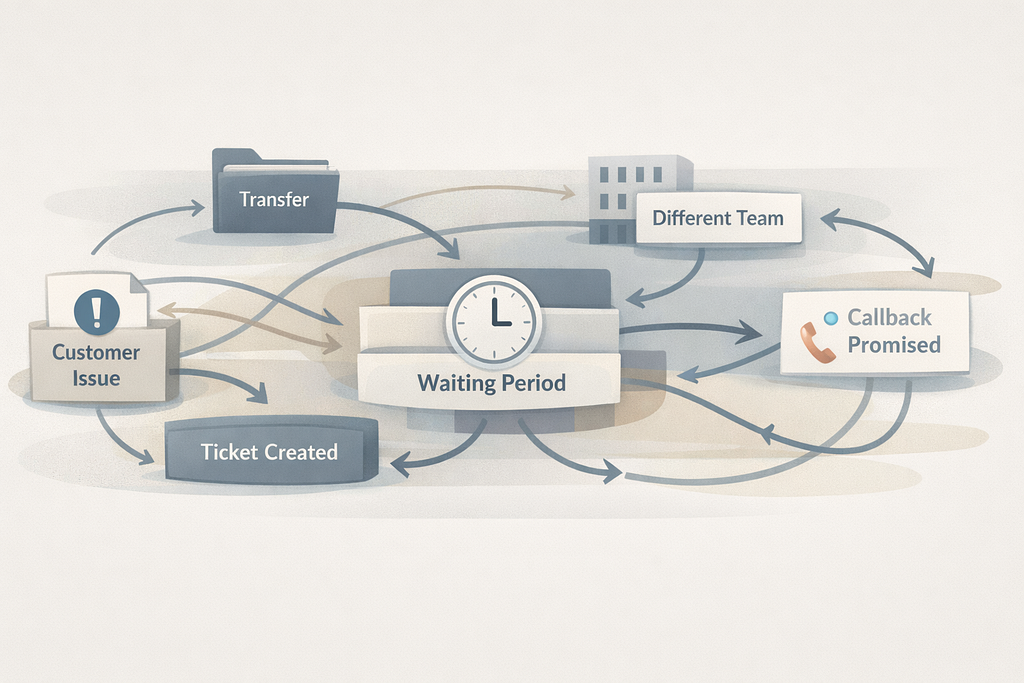
Every non-resolution creates tickets. Tickets create queues. Queues create chase work. Chase work creates more inbound contact. Back-office teams then become bottlenecks, and the frontline becomes the messenger that customers use to push the bottleneck. That is one of the fastest ways to destroy FCR further.
Churn creeps up quietly.
Not every unhappy customer comes back. Some leave. Support then becomes an upstream churn driver that no one names directly. Marketing and sales spend more to replace lost customers, and the cycle tightens.
The point is not that every program will see every effect. The point is that low FCR does not stay contained. It spreads. At 60%, it spreads fast.
Treat 60% as a symptom of broken ownership, not weak effort
When leaders see low FCR, the first reflex is coaching. Coaching matters, but at 60% the dominant drivers are often outside the agent.
Our research on non-FCR calls points to a consistent split: some misses come from customer behavior, some from agent execution, and a large share from the organization’s constraints. These are constraints the agent cannot solve mid-call.
- A handful of patterns show up again and again.
- Agents cannot see the full customer story.
- Notes are inconsistent. Case history is split across systems. Account changes are not visible in real time. Customers then repeat themselves, agents re-diagnose, and the same issue is handled as if it is new.
- Policies create a second contact by design.
“Wait 48 hours.”
“Try again tomorrow.”
“A different team will reach out.”
These statements are sometimes necessary, but often they are the default. When the policy is the reason for the repeat, the center is manufacturing demand.
Authority is too narrow at the frontline
Agents may know the fix but cannot execute it. They cannot issue the refund, reverse the fee, resend the replacement, or correct the billing state. So they create a ticket. The customer leaves without closure. The customer returns to chase the ticket.
Handoffs are treated as completions
A transfer is not a resolution. A ticket is not a resolution. A promise of a callback is not a resolution. Yet many reporting stacks count these as “handled.” That is how a center can hit service level and still bleed trust.
Product and process defects are not owned end to end
Support becomes the absorber for upstream flaws. The same broken flow creates the same repeat contacts week after week. Without a closed loop to the teams that can fix the flow, FCR cannot hold.
This is why 60% is a business emergency. It points to a system that cannot finish work at the first touch. That is ownership, not effort.
Fix the definition before fixing the number
FCR is simple to describe and easy to measure poorly. Poor measurement produces the wrong fixes, and the wrong fixes burn time and goodwill.
The definition needs to be tight in four places.
1. What counts as “resolved”?
A closed case in a system is not always a resolved customer experience. Many teams “close” cases to keep queues clean, not because the issue is done. Resolution needs to mean the customer can move on without contacting support again for the same problem.
2. The repeat window.
Some teams use 24 hours. Some use 7 days. Some use 30 days. The window should match the natural cycle of the issue. Billing disputes often need a longer window than password resets. The window should not be chosen for reporting convenience.
3. Same issue matching.
If a customer contacts again for a different topic, that should not count against FCR. If the customer contacts again for the same root issue, it should. This requires reason codes that are usable and a process that does not punish agents for choosing the right code.
4. Cross-channel repeats.
A chat that becomes a call is still a repeat. An email that becomes a chat is still a repeat. Measuring one channel at a time will undercount the misses and give false comfort.
A practical approach that builds trust is to run two measures in parallel for a while.
1. Operational FCR
Based on case closure and no reopen within the window.
2. Customer-confirmed FCR.
Based on short post-contact feedback or sampling that checks whether the customer believes the issue is finished.
The gap between these two numbers is not a problem. It is a map. It often points to false closes, unclear next steps, or work that was never truly completed.
Stop letting handle time fight resolution
Many scorecards quietly reward fast interactions and punish thorough ones. That conflict will pull FCR down over time.
AHT matters. It matters because labor cost matters. The issue is priority order.
A simple hierarchy holds up in most environments:
- compliance and safety first
- correct resolution next
- speed after that
When speed outranks resolution, the first interaction gets shorter and the second interaction gets longer. Total time across all interactions rises. Customers also become harder to serve. Agents feel it first. Supervisors feel it next. Finance feels it last, after the organization has already adapted to the repeat work.
Quality programs often make this worse by grading greetings, empathy statements, and script adherence while underweighting closure. That leads to polished calls that do not finish.
A better QA question is blunt and useful:
Did the customer leave with a completed outcome, or with a task list and a promise.
Build a first-contact system instead of relying on heroic agents
Improving FCR is less about motivation and more about removing blockers.
The work splits into two streams that should run in parallel:
capability and demand.
Capability: make closure possible
Frontline authority should match the top contact drivers. If missing refunds are a top driver, agents need clear refund rules and the ability to execute them. If order changes are a top driver, agents need the ability to modify orders within guardrails. If address changes are a top driver, agents need a single place to update and confirm.
- Knowledge needs to be short and specific. : A long knowledge base is not a tool under time pressure. Short decision steps beat long articles. Clear eligibility rules beat paragraphs. A single source of truth beats five half-updated pages.
- Tool switching needs to drop : Every extra system adds time and error. Copy-paste work creates mistakes that create repeat contacts. If tool consolidation is not possible quickly, then reduce switching for the top repeat drivers first.
- Handoffs need a contract, not a hope: When another team must act, the handoff needs a named owner, a promised timeline, and a customer update step. Without those three, the customer returns to the frontline to chase progress, and FCR drops again.
Demand: shrink avoidable contact
Top drivers should be treated as defects, not as “what customers call about.” A confusing bill line is a billing design problem. A recurring login issue is an access flow problem. A missing delivery scan is a logistics process problem. Support sees these first because customers report them. That does not mean support owns the fix.
The center needs a weekly closed loop: A weekly loop with product, policy, and operations should review the top repeat drivers, show examples, and assign owners. The output should be a short list of changes and dates, not a slide deck.
When this loop is missing, the center gets stuck doing the same work forever, just with different people.
Handle the cases that cannot be resolved in one contact without gaming the metric
Not every issue can close on the first interaction. That is normal. The mistake is treating that reality as a reason to stop using FCR.
The right move is segmentation.
Some categories are multi-step by nature, such as regulated investigations, complex fraud reviews, or third-party scheduling. For these, the goal shifts from “close in one” to “make progress in one.”
A practical measure for these categories is first-contact progress, defined as:
- the right diagnosis
- the right next step
- a named owner
- a clear timeline
- a committed customer update
These cases still need ownership and controls. They just need a different promise.
This segmentation also protects the core FCR measure. It keeps the metric honest for the work that should close and prevents complex categories from hiding poor execution in the simpler categories.
Answer the objections that show up in every leadership meeting
The same concerns surface whenever FCR becomes a priority. It helps to address them in the flow, with operating reality.
Some teams say customers contact multiple times no matter what
Some customers do, especially for high-stress issues. The pattern that matters is repeat contacts for the same root cause. When the top repeat drivers drop, total volume drops, even if a small set of customers remain high-frequency.
Some teams say higher FCR will raise handle time
Short-term, handle time may rise on the first contact because agents do more work before ending the interaction. Over time, total work falls because repeats fall. The right measure is time per resolved issue, not time per contact.
Some teams say product owns the issues, not support
Product often owns root causes, and support owns the customer in the moment. Both can be true. The center still needs to quantify the drivers and escalate them with evidence. Without that loop, product work will be driven by internal priorities instead of customer pain.
Some teams say the tools cannot change this quarter
Not every fix needs a major system change. Permission changes, better routing, clearer rules, and tighter handoffs often move FCR quickly. Those changes also build the case for larger investments by showing where the constraint truly sits.
Why 60% FCR is a business emergency
At 60% FCR, the business is paying for the same work more than once. That repeat work is harder, louder, and more expensive than the first contact. It creates new volume that stacks on top of existing volume. It also changes customer behavior in ways that increase concessions and churn.
Calling it a business emergency is not theater. It is accurate. The operation is losing control of demand and pushing cost into every corner of the business.
The fix does not require a grand initiative. It requires a clear definition, clean measurement, targeted removal of closure blockers, and a weekly loop that assigns owners for the upstream causes.
When those pieces are in place, FCR rises, repeat volume falls, and the center starts finishing work instead of recycling it. That is what relief looks like in real operations.
60% First-Contact Resolution Is Not “Okay.” It Is a Cost Multiplier was originally published in GZP Blog on Medium, where people are continuing the conversation by highlighting and responding to this story.