9 Ways Live Chat Improves Customer Service (and how to make it work)
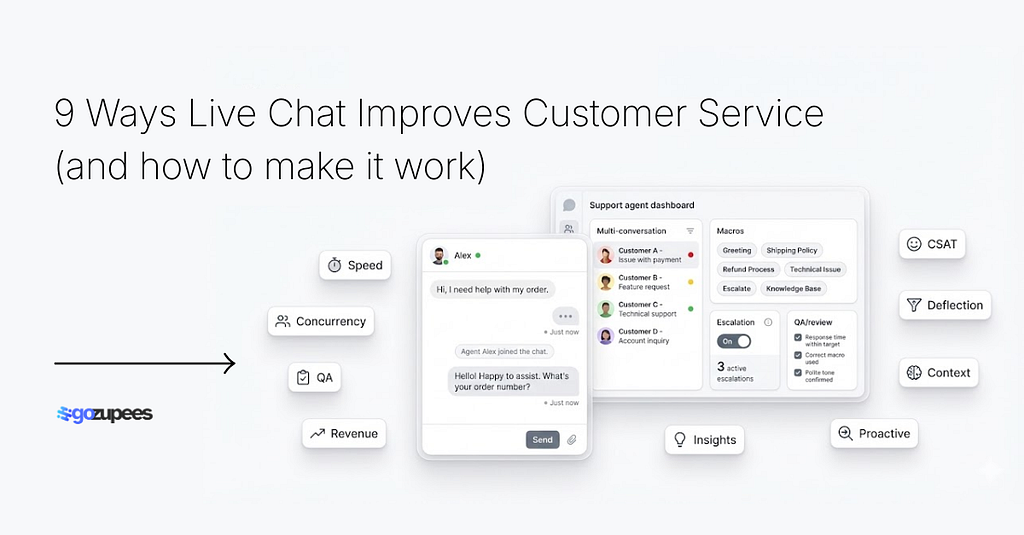
Live chat has quietly become one of the most effective customer support channels because it matches how customers want help today: fast, low-effort, and in the moment.
Adoption reflects that shift. Forrester found that 53% of US online adults had used live chat with a company’s representative in the prior six months, most commonly for customer service and post-purchase help. Forrester Zendesk’s research also noted a jump in usage among US online shoppers over time (from 38% to 58% across five years in their dataset).
Here’s what live chat improves — and why.
1) Faster help when it matters most
Chat meets customers at the exact point of friction: while they’re on your site or in your app. Our research benchmark section shows how teams track first reply time as a core live chat performance metric.
Why it matters: speed isn’t just “nice” — it reduces repeat contacts, prevents escalations, and improves perceived competence.
2) Higher efficiency because agents can handle multiple conversations
Unlike phone, chat is naturally parallel. Zendesk highlights that agents can manage multiple conversations at once, which is one reason companies see operational benefits. Salesforce’s own agent guidance similarly notes that agents can chat with several customers at the same time.
Why it matters: concurrency lowers cost-per-resolution and keeps L1 support scalable during spikes.
3) Strong customer satisfaction when executed well
Zendesk’s report describes live chat as a “clear winner” for satisfaction versus other channels.ICMI also cites benchmark comparisons showing higher satisfaction for chat than email and phone (as reported from Econsultancy data).
Why it matters: customers tend to reward experiences that feel immediate and effortless.
4) Reduced ticket volume in slower channels (especially web forms)
One of the biggest “hidden wins” of live chat is what it replaces. Zendesk found that after implementing live chat, ticket volume from embedded web forms drops sharply, and later explains how chat absorbs requests that would otherwise go into less immediate queues.
Why it matters: shifting volume from slow channels to real-time resolution improves backlog health and customer patience.
5) Better context retention (customers don’t have to repeat themselves)
Chat produces an instant transcript. That means less “start over” friction and cleaner escalations: the next agent or team can see the entire interaction history without relying on memory or notes.
Zendesk’s research emphasises that live chat is often preferred because it’s quick, convenient, and integrated into the moment customers need help.
Why it matters: fewer repeats → lower customer effort → fewer complaints.
6) Proactive support that prevents issues before they become tickets
Live chat can be proactive (when done responsibly). Zendesk notes that teams can proactively start conversations with visitors who may need help navigating the purchasing process.
Examples that work:
- checkout hesitation (“Need help with delivery dates?”)
- pricing page confusion (“Want help choosing a plan?”)
- repeat visits to the same help article (“Still stuck?”)
Why it matters: proactive chat reduces abandoned journeys and prevents avoidable contacts.
7) Faster discovery of what’s broken in your CX
Chat is a goldmine for “why customers contact us” analysis because it’s structured, timestamped, and text-based. Zendesk’s report describes examining data to understand how chat affects operations and what drives positive chat satisfaction.
Why it matters: the fastest way to improve CX is to systematically remove the top friction points (not guess).
8) Stronger coaching and quality management (because every interaction is reviewable)
With chat, QA isn’t limited to “call listening time.” Leaders can review, sample, tag, and coach using real transcripts. Zendesk calls out the use of live chat analytics and metrics to understand activity and improve efficiency and satisfaction.
Why it matters: better coaching improves tone, accuracy, and consistency — especially in L1.
9) Tangible commercial impact (conversion, revenue, retention)
Live chat isn’t only a support channel — it often influences purchase decisions by answering questions at the moment of intent. Forrester research has been widely cited as linking chat engagement to increased order value; for example, SuperOffice reports a 10% higher average order value among customers who chatted before purchase (attributed to Forrester’s findings).
Why it matters: support that removes friction can directly reduce abandonment and increase confidence.
How to make live chat actually improve service (not just add another queue)
A simple rollout plan that works for L1-heavy teams:
- Start with the top 10–20 intents (the repeatable questions)
- Set clear routing + escalation rules (when to hand off, and with what context)
- Define staffing to avoid “missed chats” (Zendesk includes “missed chats” as a benchmarked metric for a reason).
- Build a strong macro/knowledge system so answers stay consistent
- Measure the right KPIs: first reply time, resolution time, CSAT, repeat contacts, and escalation rate
Live chat improves customer service because it’s real-time, low-effort, and scalable — especially for high-volume L1 support. The best teams treat it as an operational system (routing, staffing, QA, knowledge), not just a widget.
9 Ways Live Chat Improves Customer Service (and how to make it work) was originally published in AI for Business Academy on Medium, where people are continuing the conversation by highlighting and responding to this story.