A Practical 30/60/90 Plan for AI-First Customer Support
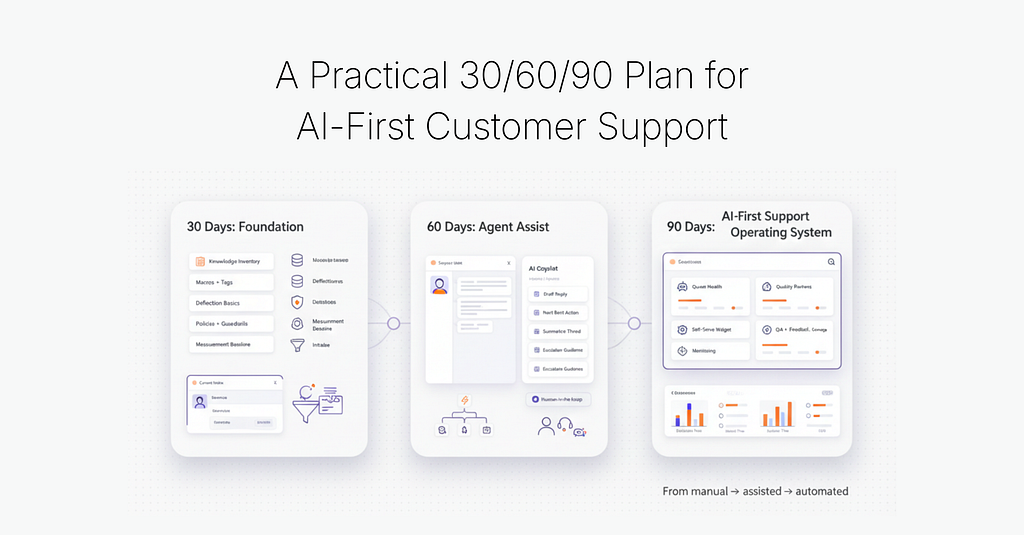
GoZupees Playbook
A simple rollout plan that protects customer trust, reduces chaos, and helps agents feel the benefit.
Most teams approach AI-first support the way they approach new software: pick a vendor, switch it on, and hope the metrics move. That’s why so many “AI launches” stall in week two — not because the model isn’t capable, but because customer service isn’t a tool problem. It’s a system.
AI changes the shape of your system. It shifts what customers expect, what work shows up for humans, how you manage quality, and even which parts of the business suddenly become dependent on support (knowledge, product changes, policy clarity, billing rules). In other words: the first 90 days aren’t about deploying AI. They’re about redesigning the service operating model around AI.
At GoZupees, we think about the first three months as a controlled transition from “human-first delivery” to “AI-first delivery with human escalation,” without sacrificing the two things that matter most in enterprise support: trust and accountability.
What follows is a practical 30/60/90 plan that’s meant to feel doable, even in a high-volume environment.
Before day 1: decide what you’re building and what you’re not
The fastest way to create chaos is to treat AI like a new channel. The second-fastest way is to treat it like a shortcut.
AI-first support is a service promise: customers will get an accurate answer quickly, and when they need a human, they’ll get one without friction or repetition. That promise only works when three foundations are in place.
First, you need a clear boundary for what AI is allowed to do. Not in marketing language (“handle common questions”), but in operational language. For example: AI can handle product how-tos and policy questions that are documented and stable; it must escalate anything involving account access, payment disputes, or high emotional intensity. When you draw this line early, you reduce risk, and you reduce the number of arguments you’ll have later.
Second, you need a definition of a “good handoff.” Most teams obsess over AI resolution rate and ignore the handoff experience. But in the first 90 days, your reputation lives in the handoff. A good handoff means the customer doesn’t have to repeat themselves, the human sees the context instantly, and the customer feels helped — not screened.
Third, you need to treat knowledge as production infrastructure. AI doesn’t “know” your business. It composes answers from what you’ve documented and what you allow it to infer. If your internal truth is scattered, outdated, or contradictory, your AI output will be confidently inconsistent — and customers will sense that immediately.
If you align on those three things, the rest becomes execution, learning, and iteration.
Days 1–30: launch a small, safe pilot and build your quality loop
Start with the use case that creates the cleanest learning
Teams often want AI to solve their hardest problems first. That’s understandable — those problems hurt the most. But the first month isn’t about heroics. It’s about establishing a repeatable mechanism for improvement.
The most reliable starting point is a customer-facing AI agent because it sits at the front door of support. It immediately reduces repetitive volume, and it gives you real conversations to learn from. It’s also familiar: customers expect a chat entry point, and support leaders already understand the concept of “self-serve + escalation.”
What matters is not the interface. What matters is that you’ve chosen a starting point where you can observe performance, update knowledge, tune behavior, and see the impact quickly.
Pick a pilot group that makes learning fast and failures survivable
A smart pilot isn’t “our biggest customers.” A smart pilot is a group that will give you high signal without high risk.
In enterprise environments, that usually means one of these slices:
- a plan tier that is meaningful but not mission-critical,
- a geography where you can monitor behavior closely,
- a segment with relatively standard use cases,
- or a single channel (web chat first, then expand).
The goal is to avoid two traps: a pilot that’s too small to generate meaningful learning, and a pilot that’s too risky to iterate on. You want enough volume to see patterns, and enough safety to fix things without reputational damage.
Build the knowledge “minimum viable truth” before you scale
Most teams interpret “knowledge prep” as “write more articles.” The better framing is: reduce contradiction and ambiguity.
In the first month, focus on the top drivers of contacts — the handful of issues that create the bulk of volume. For each one, create (or clean up) a single source of truth that answers three questions clearly:
- What is the correct policy or behavior?
- What are the steps a customer should take?
- When should this escalate to a human?
This sounds basic, but it’s where most organizations fail. They have five partial documents, two Slack threads, and one person who “knows how it works.” Humans can navigate that. AI cannot. AI will average it and output something that feels plausible — and that’s the trust killer.
Establish a weekly quality ritual from day one
If you only take one thing from this playbook, make it this: you need a weekly cadence to review reality and turn it into improvements.
In the first 30 days, a simple routine works:
- Pull a sample of AI conversations: some resolved, some escalated, some abandoned.
- Look for patterns: wrong answers, incomplete answers, confusing phrasing, and moments where customers “didn’t buy it.”
- Turn findings into changes that same week: update an article, rewrite a policy line, add a missing step, tighten escalation guidance.
This is how you avoid the “AI demo problem” — where everything looks great in a controlled scenario, but performance erodes in production. Your weekly ritual becomes the flywheel that keeps quality climbing.
What “good” looks like by day 30:
You’re not aiming for perfection. You’re aiming for control. By the end of the first month, you should be able to say: we know what AI is handling, we know where it fails, we know why, and we know how quickly we can fix it.
Days 31–60: simplify the experience and expand coverage intentionally
The second month is where many teams accidentally create a new kind of friction. They add long triage flows, more forms, and extra steps “to help humans later.” Customers experience it as deflection.
Reduce customer effort, even if it costs you a bit of internal efficiency
In AI-first support, customers judge the system as a whole. If your AI tries, then your automation interrogates them, and only then a human appears, you’ve turned support into an obstacle course.
Your strategy in month two should be simplification: fewer questions, clearer answers, faster escalation when the customer is stuck.
This doesn’t mean you throw away structure. It means you treat customer attention as scarce. If AI can’t resolve within a reasonable exchange, you stop optimizing for “perfect intake” and start optimizing for “fast relief.” A human can always ask a clarifying question. A customer won’t always tolerate ten.
Expand scope based on evidence, not ambition
By now you’ll know which topics AI handles confidently and which ones generate friction. Use that to expand in rings.
Start by broadening coverage where knowledge is stable and repeatable. Then, and only then, move into more nuanced areas where answers require interpretation, multiple sources, or customer-specific detail.
This is also the moment to tighten your guardrails. As you broaden scope, you must get more disciplined about what AI should refuse, what it should escalate, and what it should never guess at. The safest AI isn’t the one that answers everything — it’s the one that knows when not to.
Bring AI into the agent workflow so humans feel the benefit too
If your only AI win is deflection, your team will feel like AI is happening “to them,” not “for them.” Month two is the time to deliver value directly to agents.
This is where internal AI assistance can transform the experience of support work: summarising long threads, finding the right internal process, drafting a first-pass response in the right tone, or surfacing precedent from past cases. The impact is subtle but meaningful: fewer context switches, less cognitive load, faster confidence.
Adoption matters here. If it requires agents to change how they work dramatically, it won’t stick. The value must be embedded where they already operate — not as a separate dashboard that becomes “one more tool.”
What “good” looks like by day 60:
Customers feel the journey is smoother than it was in month one. Escalations are cleaner. Agents feel AI is saving them effort, not adding process. And you’ve expanded coverage in a way that didn’t spike risk.
Days 61–90: operationalise the model and redesign how success is measured
Month three is where the shift becomes real. The work that reaches humans becomes harder. If you keep measuring humans with old metrics, you will unintentionally degrade morale and quality.
Update performance metrics to match the new reality
When AI removes repetitive tier-one work, the remaining human queue becomes more complex, emotionally charged, and ambiguous. Handle time goes up. Case count per agent goes down. Escalations become less predictable.
That’s not underperformance — that’s the new job.
So success measures need to evolve toward:
- quality of resolution and ownership,
- clarity and empathy in complex situations,
- effectiveness of escalation handling,
- and contribution to system improvement (closing knowledge gaps, flagging product issues, improving workflows).
This is how you keep support work meaningful. People stay motivated when they’re evaluated on what matters, not punished for the system changing.
Formalise the new roles that are already emerging
If you’re doing this well, you’ll notice new kinds of work appear: knowledge stewardship, conversation design, AI quality review, workflow tuning, cross-functional coordination.
Don’t leave this as invisible labor done by your highest performers “on the side.” Give it time allocation. Give it ownership. Give it recognition. In enterprise environments, this is the difference between a sustainable operating model and a fragile one held together by heroic individuals.
Build trust deliberately — because correctness alone isn’t enough
One of the most surprising lessons teams learn is that customers will sometimes challenge the AI even when it’s right. This isn’t irrational. It’s learned behavior from years of bad automation.
So month three is where you shift from “make it accurate” to “make it believable.”
Believability comes from:
- answers that lead with the outcome, not a wall of text,
- language that signals confidence without arrogance,
- the ability to reference policy or documentation clearly,
- and a handoff experience that feels supportive, not defensive.
Customers trust systems that behave like accountable professionals: concise, clear, and willing to escalate rather than bluff.
What “good” looks like by day 90:
AI-first support is no longer a pilot. It’s an operating rhythm. You have a quality flywheel. You have clear boundaries. Your team’s work is more complex but more valued. And customers feel they’re being helped — quickly — without the “support maze.”
Don’t chase “AI adoption,” build “service reliability”
The teams that win with AI aren’t the ones that switch it on fastest. They’re the ones that treat AI as a new production system: with boundaries, monitoring, iteration, and ownership.
In 90 days, you don’t need to transform everything. You need to prove a reliable, repeatable model — and then scale it.
A Practical 30/60/90 Plan for AI-First Customer Support was originally published in AI for Business Academy on Medium, where people are continuing the conversation by highlighting and responding to this story.