AI Copilot for Support Teams: Faster Resolutions Without Losing the Human Touch
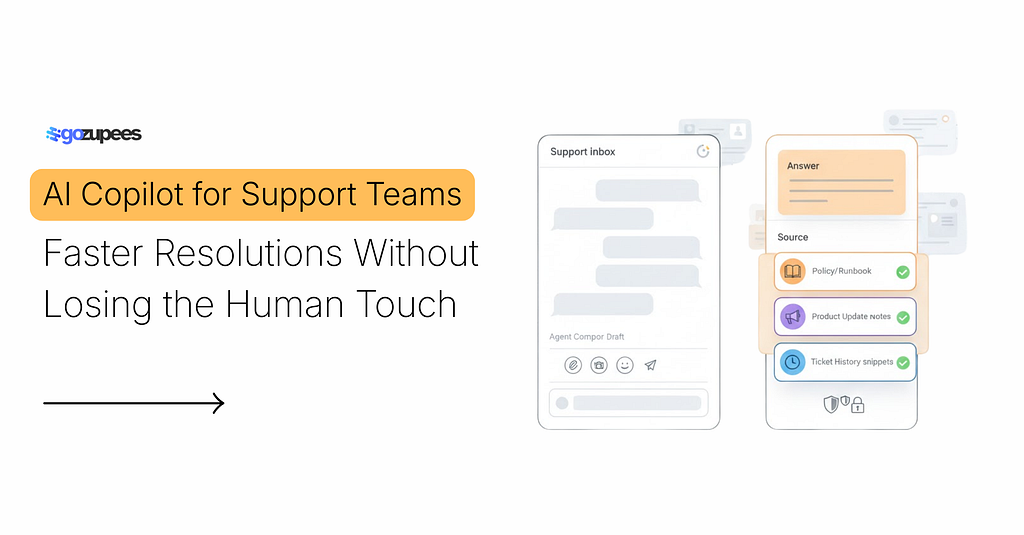
A GoZupees perspective on faster resolutions, better quality, and more meaningful support work
For most support teams, the biggest bottleneck isn’t empathy, effort, or even skill.
It’s retrieval.
A customer asks a question. The agent could answer it — but only after opening six tabs, hunting through internal docs, scanning old tickets, asking in Slack, double-checking whether something changed last week, and then translating all of that into a clean, customer-friendly response. Multiply that by hundreds of conversations a day and you end up with a strange reality: some of your most capable people spend an uncomfortable amount of their day searching, not supporting.
AI Copilot changes that dynamic. Not by replacing the agent, but by pulling the “finding” and “remembering” work forward so the agent can stay in the conversation and do what humans do best: understand context, make judgment calls, and build trust.
This is what an AI-first support org starts to look like at GoZupees.
The real problem AI Copilot solves: context switching
Support teams have quietly become expert jugglers. On a single ticket, an agent might need to reference:
- the public help center (what customers are supposed to see)
- internal runbooks (what agents actually do in edge cases)
- product notes (what’s changed recently)
- billing rules (what’s allowed vs. what’s “nice to do”)
- historical conversations (how we solved this last time)
- and “tribal knowledge” living in people’s heads
The cost isn’t just time. It’s quality drift.
When agents are forced to hunt, they take shortcuts. They reuse old phrasing that no longer fits. They over-explain to protect themselves from being wrong. They escalate earlier than necessary because it’s faster than searching. Or they guess.
AI Copilot is designed to collapse that entire scavenger hunt into a single step: ask inside the inbox, get an answer you can verify, and respond without losing your place.
That sounds small. In practice, it changes the economics and the experience.
What AI Copilot actually is (and what it isn’t)
AI Copilot is not “a chatbot for customers.”
It’s an expert assistant for agents, embedded where work happens, that helps an agent move from question → answer → action without leaving the workflow.
And importantly: it doesn’t need to be treated like magic to be valuable. The most useful Copilot experiences are grounded in three simple capabilities:
1) It finds answers across your knowledge ecosystem
A strong Copilot can pull from multiple sources — public and internal — and synthesize what’s relevant instead of dumping a list of links.
At GoZupees, that matters because “truth” rarely lives in one place. Policies live in one place, product details in another, and edge-case handling in internal notes. Copilot’s job is to bring the right pieces together, in the moment, in a way an agent can confidently stand behind.
2) It learns from your ticket history
This is the underused gold mine: your support org has already solved most problems before — but those solutions are trapped inside closed tickets.
A good Copilot turns past cases into reusable intelligence. That doesn’t mean blindly copying old replies. It means surfacing proven resolutions, common pitfalls, and the “missing step” that usually unlocks the fix — so newer agents can work like seasoned ones faster, and experienced agents stop reinventing the wheel.
3) It keeps the human in control
Support is not just information delivery. It’s judgment.
Copilot should make it easier for the agent to verify, adjust tone, choose the right level of detail, and escalate when needed. The win isn’t autonomy. The win is confidence + speed without sacrificing accuracy.
Why it improves customer experience (not just efficiency)
It’s easy to talk about time savings, but the bigger unlock is customer experience quality. When agents don’t have to context-switch constantly, you get better service patterns almost automatically:
Faster, yes — but also calmer
Customers can feel “searching energy.” They feel when an agent is scrambling or stalling. Copilot reduces that lag, which makes the interaction feel more assured and intentional.
More consistent answers across the team
When information is scattered, each agent becomes their own version of the company. Some explain well. Some are brief. Some over-promise. Some are overly strict.
Copilot helps standardize what “correct” looks like — especially for policy, billing, and configuration — while still allowing agents to be human.
Better handling of complex, high-stakes moments
AI agents can take a lot of routine volume. But the conversations that reach humans are increasingly nuanced: escalations, edge cases, emotional situations, multi-step troubleshooting, VIP accounts.
Copilot gives agents time back inside those hard conversations, which is exactly where “remarkable support” becomes possible.
The hidden superpower: it changes how teams use knowledge
Once Copilot is live, your internal knowledge stops being a dusty library and starts behaving like a production system. That creates a healthy pressure: if the Copilot answer is unclear, inconsistent, or outdated, it becomes visible immediately — inside real work.
This is where GoZupees teams see the strategic shift.
Knowledge becomes a shared operational responsibility
When Copilot exposes gaps, it’s no longer “support’s problem” to fix documentation. Product, engineering, ops, and CS all have a reason to contribute because the outputs show up in customer conversations.
You stop writing content for the sake of content
Instead of publishing articles because “we should,” you write and refine knowledge because it directly improves resolution quality, reduces escalations, and lowers recontact rates.
The feedback loop tightens
Great support orgs run on loops:
- a customer asks something
- the agent notices friction
- the team updates the knowledge
- the next customer gets a better answer instantly
Copilot accelerates that loop because it sits at the point of friction and makes gaps obvious.
What changes for the agent day-to-day
This is the part most people underestimate. Copilot doesn’t just make agents faster — it changes the shape of their work.
Here’s what that looks like in practice:
- Less hunting, more thinking.
- Agents spend less time locating facts and more time understanding what the customer is really trying to do, which is where better outcomes come from.
- More reliable first responses.
- Instead of starting with a generic “can you clarify,” agents can begin with a confident direction — and ask for the right missing detail, not a scattershot list.
- Better onboarding for new hires.
- The gap between a new agent and a senior agent often isn’t capability — it’s memory. Copilot shortens the time-to-confidence by giving new hires access to institutional knowledge without needing to know who to ask.
- A new standard for quality.
- When it’s easy to get the right info, the bar rises. Customers will notice. Teams will notice. And “good enough” replies become harder to justify — in a good way.
How to roll out AI Copilot without chaos
Copilot is easiest to adopt when you treat it like a workflow upgrade, not a novelty feature.
Start with the highest-friction moments
Pick use cases where agents lose the most time and confidence:
- policy questions (refunds, billing, eligibility)
- “how do I…” setup flows with lots of steps
- troubleshooting that requires cross-referencing multiple sources
- anything that triggers internal Slack pings (“does anyone know…?”)
These moments create quick wins because Copilot replaces real pain, not theoretical pain.
Make verification a habit, not a burden
The healthiest Copilot culture is: trust, but verify.
Early on, coach agents to treat Copilot like a sharp assistant:
- confirm the answer’s source
- sanity-check against recent changes
- adjust phrasing for the customer’s context
This builds confidence and prevents “AI says so” responses, which customers hate.
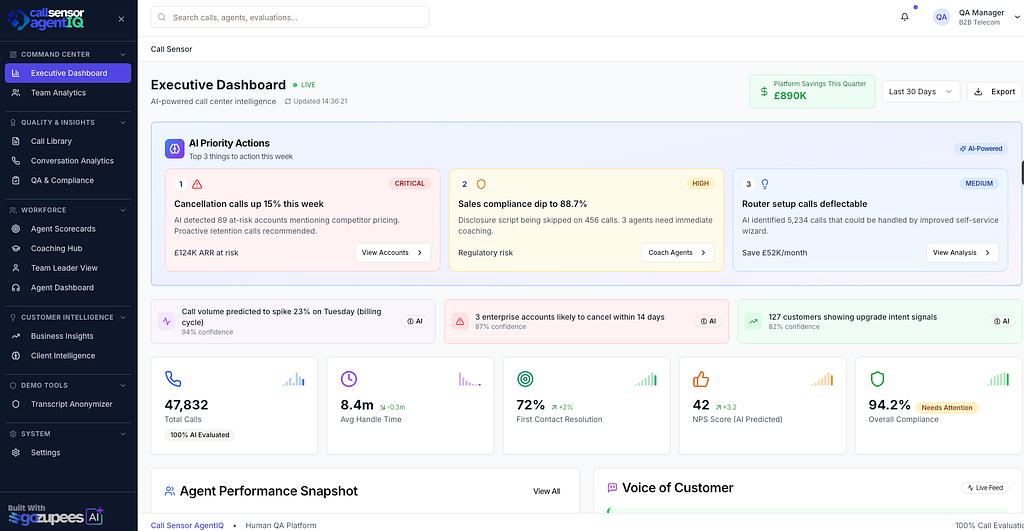
Use Copilot questions as your knowledge roadmap
The questions agents ask Copilot are incredibly valuable. They tell you:
- what knowledge is hard to find
- what isn’t documented clearly
- what’s changing faster than your docs keep up with
If you build a lightweight process to capture and fix those gaps, your Copilot gets better every week — and so does your support org.
The bigger picture: AI-first isn’t about replacing humans
The future isn’t “AI support” versus “human support.”
It’s a system:
- AI handles the repetitive, the immediate, the always-on
- Humans handle the complex, the emotional, the ambiguous
- Copilot makes humans faster, more consistent, and more confident
- Knowledge becomes the foundation that makes all of it trustworthy
That’s the game change.
AI Copilot doesn’t just speed up replies. It makes support work feel less like chasing information and more like solving problems — which is what great customer service was supposed to be in the first place.
AI Copilot for Support Teams: Faster Resolutions Without Losing the Human Touch was originally published in AI for Business Academy on Medium, where people are continuing the conversation by highlighting and responding to this story.