How to Build an AI-Ready Knowledge Base for Customer Support
AI can make customer service faster, more scalable, and more consistent but only if you stop treating knowledge as “documentation” and start treating it like infrastructure.
Most companies try to adopt AI by changing the front end: new chatbot, new assistant, new widget. The winners change the back end first: what the AI is allowed to know, how it retrieves that knowledge, and how that knowledge stays true as the business changes.
This guide is a practical playbook for building that system.
What AI-optimized knowledge management actually means
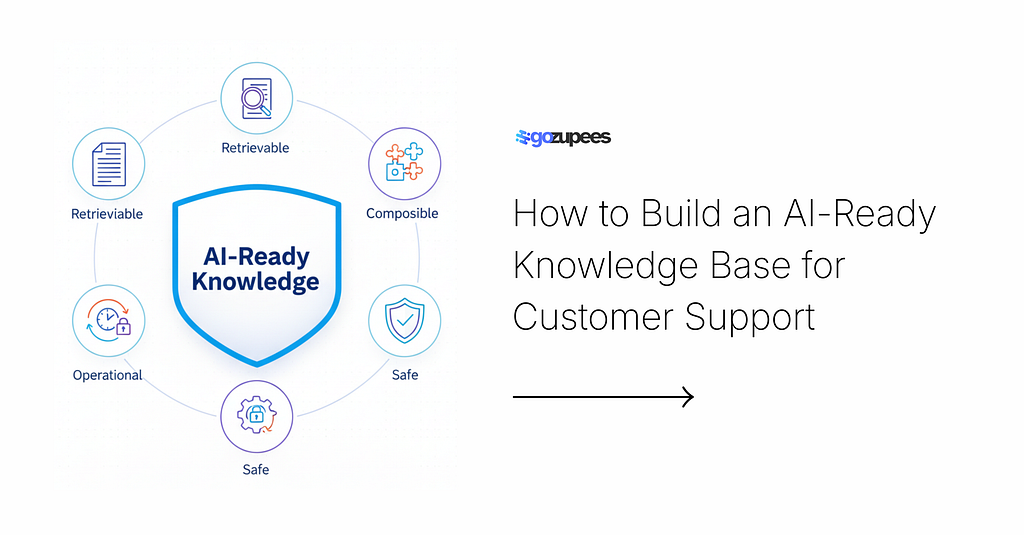
Knowledge management has always included creating and maintaining information. AI changes the bar because now your knowledge needs to be:
- Retrievable: the AI must reliably find the right snippet for the right question.
- Composable: the AI must be able to combine multiple snippets without contradiction.
- Current: the AI must not be trained on yesterday’s truth.
- Safe: the AI must not invent policy, legal commitments, pricing promises, or security claims.
- Operational: updates must happen as part of “how the company ships,” not as an afterthought.
This is why “good documentation” is not enough anymore. You need knowledge as an operating model.
Step 1: Build your knowledge map before you “clean anything”
Most teams begin by editing articles. That feels productive — but it’s often the wrong first move.
Start by mapping where your knowledge currently lives. The goal is to identify contradictions, ownership gaps, and “truth sources” before AI starts stitching them together.
Your knowledge typically falls into five buckets
Use this as your initial inventory. Don’t just list the sources — write down what each source is trusted for.
Customer truth (public knowledge):
- This is what you are willing to stand behind externally: help center content, pricing pages, policy pages, integration docs, onboarding guides.
- Why it matters: AI answers that reference public truth are easier to defend. When customers challenge the AI, you can point to published policy or product docs.
Operational truth (internal support knowledge):
- Escalation paths, triage checklists, internal “how we handle this,” exception handling, outage playbooks, risk rules, refund edge cases, compliance guardrails.
- Why it matters: This is where teams actually resolve hard cases — and it’s usually where the biggest AI productivity gains live (copilots and agent assist).
Product truth (technical reality):
- Engineering docs, release notes, feature flags, system limitations, data flows, permissions logic, known bugs.
- Why it matters: Product truth changes quickly. If AI can see product truth but you don’t control it, you’re asking for inconsistency.
Commercial truth (business rules):
- Plan entitlements, SLAs, invoice logic, contract constraints, regional variations, discount policies, cancellation rules.
- Why it matters: AI errors here cost real money and create legal risk. This bucket needs the strongest governance.
Conversation truth (what customers really ask):
- Past tickets, chat logs, email threads, call summaries, “voice of customer” tags, contact drivers.
- Why it matters: This bucket tells you what to write next. It’s demand data — and it prevents KM from becoming guesswork.
Outcome of Step 1: You’re not just collecting content. You’re defining what counts as truth — and what must never be treated as truth.
Step 2: Decide your “source-of-truth hierarchy” (or AI will create one for you)
AI will often pull from multiple sources. If two sources disagree, the AI can sound confident either way — because it doesn’t “feel” uncertainty the way humans do.
So you need a hierarchy that decides what wins.
A practical GoZupees hierarchy looks like this
(Adjust to your business — but choose something explicit.)
Policy and legal commitments win over everything.
- If your privacy policy, refund policy, or security statement says X, then X is the answer — even if an older help article says Y.
- Practical impact: These documents should be short, unambiguous, and tightly controlled.
Product truth wins over help center phrasing.
- If the product behaves differently than the article describes, fix the article — don’t ask AI to “explain around it.”
- Practical impact: Your KM process must include a feedback loop from support → product → documentation.
Help center wins over internal “tribal memory.”
- If agents solve something using Slack lore but it isn’t documented, AI will never reliably scale it.
- Practical impact: Make “document the fix” part of the resolution workflow for repeatable issues.
Conversation history is guidance, not authority.
- Past tickets can teach AI patterns, but they also contain outdated answers, one-off exceptions, and inconsistent agent behavior.
- Practical impact: Past conversations are useful for drafting and discovering gaps — not for being treated as canonical truth.
Outcome of Step 2: AI isn’t just “smarter.” It’s now governed.
Step 3: Prioritize what to write using support economics, not intuition
A common KM trap is writing what’s easy to write, or what leadership wants to talk about, instead of what changes outcomes.
Instead, prioritize content based on volume, cost, and risk.
Use these four lenses when choosing what to create next
Volume: “How often does this come in?”
High-volume topics are where AI will deliver immediate ROI, because each improved article reduces a repeated workload.
Handle time: “How long does this take to resolve?”
Some topics aren’t frequent but consume huge time. AI-ready troubleshooting can collapse resolution cycles dramatically.
Recontact rate: “Do customers come back after the answer?”
Recontacts signal that your content is unclear, incomplete, or missing prerequisites. These are the most valuable fixes because they reduce frustration and work.
Risk: “What happens if AI gets this wrong?”
Billing, data, security, legal, and compliance topics must be treated differently: tighter language, stricter routing, higher thresholds for escalation.
A useful rule:
Start with high-volume, low-risk, then move to high-handle-time, then take on high-risk once governance is strong.
Step 4: Write knowledge in a structure AI can reliably use
AI doesn’t need “beautiful prose.” It needs clear decision logic and retrievable chunks.
Use bullets — but make them do real work
Here’s a GoZupees article structure that consistently improves AI answer quality:
Start with the direct answer (one paragraph).
- Customers come for outcomes. Give the punchline immediately, then explain.
- This reduces “I don’t believe you” reactions because it removes the feeling of being led through filler.
Add eligibility and prerequisites as explicit bullets — with meaning.
- Don’t just list requirements. Explain why each matters.
- Example:
“You must be an Admin to change billing details.” (Because billing changes affect invoice ownership and payment authorization.) - That little explanation prevents customers from treating the rule as arbitrary.
Provide step-by-step resolution that is unskippable.
- Each step should be a complete instruction. Avoid vague verbs like “configure” or “set up.”
- If there are branches, label them clearly: “If you’re using X, do this. If Y, do that.”
Include failure modes: “If this doesn’t work…”
- AI answers become dramatically more trusted when they anticipate reality.
- Customers don’t distrust AI because it’s wrong — they distrust it because it sounds like it doesn’t understand the messiness of real life.
- A strong failure-mode section signals competence.
Define escalation criteria clearly.
- Don’t just say “contact support.”
- Say what to send, why it’s needed, and what happens next.
- Example:
“If you see error code 403 after enabling X, contact support with: workspace ID, timestamp, and screenshot. This lets us confirm whether access permissions are blocking the request.”
This structure is not only AI-friendly — it’s customer-friendly.
Step 5: Make internal knowledge your advantage (this is where most teams win)
Public knowledge helps customers self-serve. Internal knowledge helps your team resolve edge cases.
And internal knowledge is where AI copilots can save hours, because they reduce the “hunt” — switching tools, searching Slack, guessing, asking senior teammates.
What internal knowledge should include (with depth)
Decision trees for nuance, not scripts.
- The goal isn’t to standardize personality — it’s to standardize judgment.
- Example: billing disputes should include what you can refund, what requires approval, what evidence is needed, and what language to avoid.
Known issues with customer-safe language.
- Engineers often describe issues in ways that are technically accurate but customer-hostile (“race condition,” “cache invalidation,” etc.).
- Translate technical truth into customer-safe truth that preserves trust.
Escalation paths that remove customer burden.
- A remarkable experience is when the customer doesn’t have to coordinate your teams.
- Internal docs should make cross-team handoffs invisible to the customer by defining: who owns it, what info is required, and expected timeframes.
Examples of “good outcomes.”
- Include a few anonymized examples of what excellent looks like:
- a great de-escalation, a clean troubleshooting flow, a proactive customer education moment.
- This helps AI assist agents with tone and structure without turning them into robots.
Step 6: Governance that actually works (without bureaucracy)
Governance fails when it becomes paperwork. It succeeds when it becomes habit.
The minimum governance system GoZupees recommends
Assign real owners by domain, not one “knowledge person.”
- One person can orchestrate, but they can’t own billing truth, security truth, product truth, and onboarding truth simultaneously.
- Domain ownership ensures accuracy because the people closest to change own the updates.
Attach knowledge updates to change events.
- Knowledge should update when:
- product ships
- policy changes
- pricing changes
- a recurring incident happens
- a new class of customers arrives
- This is the single biggest difference between “a knowledge base” and “a knowledge system.”
Introduce a lightweight “knowledge request” workflow.
- Make it easy for frontline teams to flag gaps while working tickets.
- The trick is to capture context:
- what the customer asked, what was missing, and what the correct answer should have referenced.
Review cadence based on risk.
- Not everything needs monthly review.
- High-risk docs (billing/security/legal) should have frequent, scheduled review.
- Low-risk tutorials can be reviewed less often — but still must have an owner.
Step 7: Measure knowledge like a performance engine, not a library
If you only measure CSAT or time-to-first-response, you’ll miss whether knowledge is getting stronger.
Metrics that actually tell you if KM is working
AI-to-human handover reasons, not just handover volume.
- “Handover” isn’t failure. The reason matters:
- missing content
- unclear content
- policy ambiguity
- customer emotion
- action required
- Your KM strategy changes depending on which bucket dominates.
Recontact rate on topics AI answered.
- This is the clearest signal of whether content is actually resolving or merely replying.
Searches with no result (or no click).
- This shows you what customers and agents are trying to find — and failing.
Time-to-competence for new agents.
- Strong internal KM + AI assist should shorten ramp time. That’s a real economic advantage.
Trust signals: “I want a human” after a correct answer.
- This is often a knowledge presentation problem: too wordy, too vague, missing “why,” or missing next steps.
A GoZupees 90-day rollout plan that doesn’t collapse under reality
Days 0–30: Stabilize truth
- Map knowledge sources and contradictions.
- Define the hierarchy of truth.
- Fix the top 10 high-risk docs first (billing, policy, security).
- Standardize an article template so future content doesn’t drift.
Days 31–60: Build leverage
- Create content for top contact drivers (high volume).
- Write internal runbooks for your top escalation paths.
- Turn recurring solutions into structured troubleshooting guides.
- Introduce a “gap capture” workflow so frontline insights become content.
Days 61–90: Operationalize continuous improvement
- Tie knowledge tasks into product launch checklists.
- Establish review cadences by risk category.
- Create a weekly KM standup: “what changed, what broke, what we learned.”
- Use real conversation data to rewrite the top 10 unclear articles for clarity and trust.
AI doesn’t reduce the need for knowledge — it exposes whether you have it
The strongest AI-first support teams don’t win because they bought a tool.
They win because they built a truth machine: knowledge that is accurate, structured for retrieval, governed like a product, measured like performance, and updated as a natural consequence of change.
How to Build an AI-Ready Knowledge Base for Customer Support was originally published in AI for Business Academy on Medium, where people are continuing the conversation by highlighting and responding to this story.