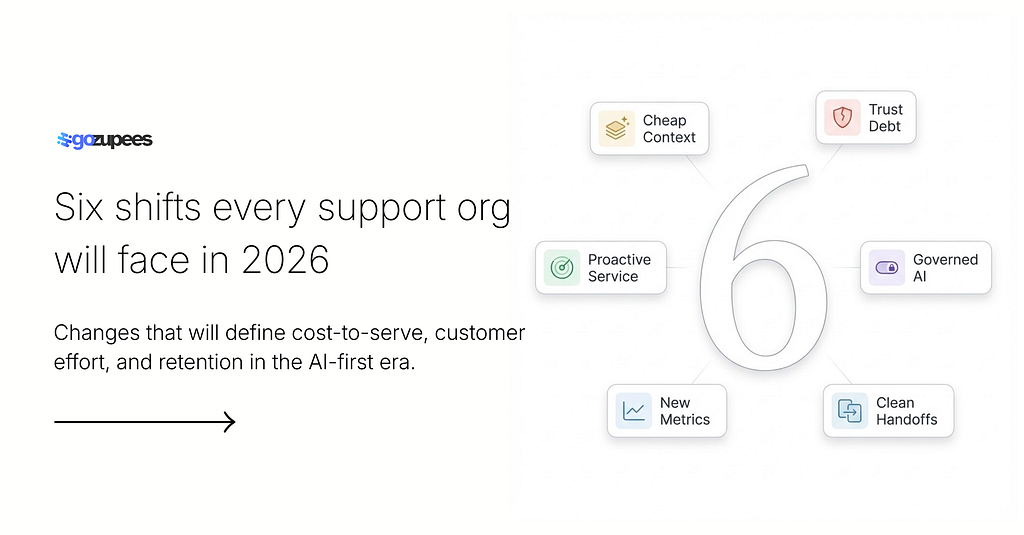
Six shifts every support org will face in 2026
GZP Reality Check 2026
Changes that will define cost-to-serve, customer effort, and retention in the AI-first era.
Most companies in 2026 will add AI. Fewer will rebuild the service operating model around it. The difference won’t be cosmetic — it will be compounding. One group gets more capacity, faster resolution, and a better customer experience without linear headcount. The other gets a thin layer of automation… and a spike in escalations when reality hits.
For years, “customer service trends” were a reliable way to plan. You watched channels shift, adjusted staffing, refined deflection, adopted new tools, and set priorities for the next 12 months.
That approach still matters — it’s just no longer sufficient.
AI isn’t a feature you bolt onto support. It changes the fundamentals of how service runs: how customers ask for help, how work enters the organization, how context is gathered, how issues are diagnosed, and how value is created long after a ticket is marked “closed.”
The good news is this: when AI is adopted deliberately, it doesn’t just reduce cost-to-serve. It expands what your support organization is capable of delivering — speed, consistency, and coverage — while giving humans room to focus on the work that actually builds trust and retention.
And adoption has already moved from “early experiments” to mainstream momentum:
76% of support teams invested in AI in the last year,
up from 56% the year before, and
79% plan to invest again this year.
At GoZupees, we see the winners in this era separating themselves in one way: they stop treating AI as a tool to “install,” and start treating it as a capability to operate.
What follows is a practical, enterprise-ready approach to navigating the AI-first shift — without sacrificing experience quality, governance, or your team’s confidence.
1) Accept the new baseline: speed is now expected, not celebrated
Customers don’t wake up hoping to “talk to support.” They want the fastest path back to value. As more companies implement competent AI help, the tolerance for slow, form-based, back-and-forth support is dropping — because customers have seen the alternative.
This is why AI-first is less about novelty and more about expectations reset. Research indicates 89% of support teams believe customer attitudes toward AI have changed in the past 12 months, and most believe customers feel positive or neutral about it.
The implication is straightforward:
If your service model still depends on customers patiently explaining context over multiple turns, you’re building friction into the experience — and customers will compare you to whoever removed it.
2) The real transformation is economics: support is no longer linear
Historically, support scaled like this:
More customers → more tickets → more headcount → more cost
AI breaks that model. Not by eliminating humans, but by changing what humans spend time on. Industry data shows 81% of teams agree AI is changing the economics of customer service.
But here’s the part many teams miss: the goal is not “reduce cost.” The goal is increase capacity for high-value work without adding proportional cost.
AI can take on a meaningful share of repetitive informational queries. That doesn’t just cut queue pressure — it creates room for humans to do the work that actually moves the business:
- diagnosing ambiguous issues faster,
- preventing repeat contacts,
- improving onboarding and adoption,
- feeding product and ops with sharper insight,
- handling emotionally sensitive or high-stakes situations with care.
In AI-first support, efficiency isn’t the finish line. It’s the fuel for better outcomes.
3) The biggest hidden cost in support is misdiagnosis
Most organizations underestimate how much time is wasted before solving even begins. The expensive part isn’t the resolution — it’s the prolonged discovery: unclear descriptions, missing context, internal escalation loops, and repeated “can you send a screenshot/log/steps?” exchanges.
AI-first support creates a new opportunity: compress time-to-understanding.
That can happen in a few ways:
- AI frontlines can ask smarter clarifying questions immediately, instead of after an agent picks up the ticket hours later.
- Internal copilots can summarize history, detect intent, and surface the most relevant knowledge without forcing agents to hunt.
- Better intake (forms, guided flows, screen recordings, structured fields) can be orchestrated so the ticket arrives “pre-diagnosed.”
This is where service leaders win disproportionate gains: fewer touches, fewer escalations, and fewer reopened cases — which improves both customer effort and agent fatigue.
4) Use a practical operating framework: Team, Tools, Process, Feedback
AI-first customer service can feel overwhelming because it changes many parts at once. We recommend anchoring on four pillars and treating them as a system:
Team: redefine what “good” looks like
When AI takes the easy work, the remaining work becomes more complex by definition. That means metrics, staffing profiles, coaching, and career ladders need to evolve.
High-performing teams are:
- raising the bar on technical and diagnostic skill,
- formalizing new specialties (knowledge ownership, conversation design, automation ops),
- retraining frontline teams to work with AI outputs critically (not accept them blindly).
The best outcome isn’t “agents using AI.” It’s agents becoming better decision-makers because AI reduces noise.
Tools: pick systems that reduce operational drag
One of the clearest signals in the market: 81% of teams say their tools don’t always fully support their needs.
That frustration isn’t about shiny features — it’s about day-to-day reliability:
- Can the AI work inside your existing workflows, or does it create parallel processes?
- Can you govern outputs, segment experiences, and control escalation?
- Does performance improve as knowledge changes, or does it degrade?
At enterprise scale, “cool demo” is irrelevant. Operational fit is everything.
Process: build a service assembly line, not a heroic rescue mission
AI-first support works when you design for:
- predictable intake,
- fast diagnosis,
- clear handoffs,
- measurable outcomes,
- continuous improvement.
If your escalation process still depends on tribal knowledge, AI won’t fix that — it will amplify inconsistency. The organizations that win treat service like a product: designed, documented, improved.
Feedback: close the loop at the source of truth
AI creates a new kind of feedback loop: every conversation is data, and every gap is a chance to strengthen knowledge, workflows, and routing.
The goal isn’t more dashboards. The goal is a tight system where:
- repeated questions trigger content updates,
- poor AI answers trigger knowledge fixes,
- escalations reveal product friction,
- customer effort signals show up in leadership reporting.
5) A phased rollout beats a “big bang” launch
If you want a practical way to start without risking customer trust, sequence adoption in layers:
Layer 1: Assist humans first
Deploy copilots for summarization, knowledge retrieval, translation, and drafting. This builds team confidence and improves consistency while keeping humans accountable.
Layer 2: Automate low-risk, high-volume intents
Turn on AI handling for clear informational queries where your knowledge is strong (pricing, policy, how-to). Constrain scope and monitor closely.
Layer 3: Expand by segment and complexity
Introduce segmentation: new users vs power users, free vs paid, low vs high risk. Scale coverage intentionally rather than universally.
Layer 4: Instrument learning and governance
Define who owns AI quality, knowledge health, and workflow rules. Without ownership, performance decays.
This approach matches what we see in adoption data: AI investment is accelerating, but the differentiator is how well teams operationalize it, not whether they “turned it on.”
6) What “great” looks like in AI-first customer service
In the old world, great support meant: fast response, friendly tone, correct answer.
In the AI-first world, great support means:
- Instant for the simple (and accurate enough to trust),
- Expert-level for the complex (humans with time and context),
- Seamless across departments (customers don’t get bounced),
- Continuously improving (every interaction strengthens the system).
And importantly: customers should feel the humanity of your brand even when AI is involved. That’s not about pretending the AI is a person — it’s about designing an experience that is clear, helpful, and respectful of their time.
AI-first is a leadership moment, not a tooling decision
The organizations that win this era won’t be the ones with the loudest AI story. They’ll be the ones that redesign service around a new reality:
- customers expect immediacy,
- support economics have changed,
- diagnosis is the new bottleneck,
- roles are becoming more strategic,
- and the service experience is becoming a competitive differentiator again.
AI-first customer service is not about replacing teams. It’s about building a system where humans do the work only humans can do — with the time, context, and leverage to do it exceptionally well.
Six shifts every support org will face in 2026 was originally published in AI for Business Academy on Medium, where people are continuing the conversation by highlighting and responding to this story.