The AI-Native Company: A Manifesto for the Business Of 2026
AI Strategy In Action
10 Commandments of adopting AI as part of your DNA
This document is an edited and expanded version of the GoZupees internal manifesto, based on our daily practices and the principles that guide our company. We’re sharing it not as a finished playbook, but as a living document and a guide for companies ready to make the leap to becoming truly AI-native.
Why Most Companies Will Fail at AI (And How to Avoid It)
By 2026, there will be only two kinds of companies: AI-native and legacy.
The distinction will not be about who uses AI, but about who has rebuilt their organization from the ground up with AI as its core operating system.
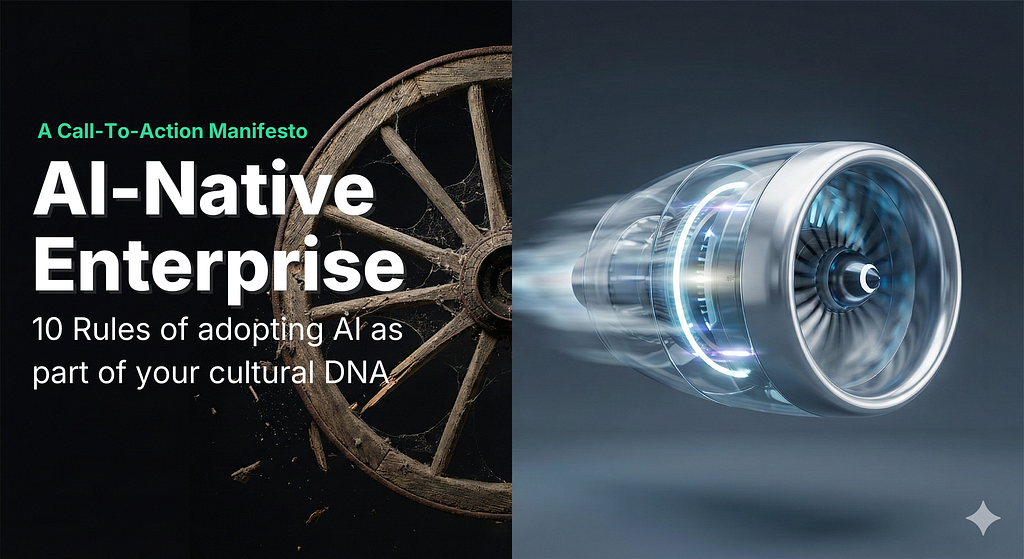
For years, businesses have treated AI as a feature, a project, or a tool to be bolted onto existing processes. This approach is doomed to fail. It’s like trying to put a jet engine on a horse-drawn carriage.
You get a lot of noise and smoke, but you don’t get a jet. The underlying system is the bottleneck.
An AI-native company does not just use AI; it is built on AI. Every process, every workflow, and every role is re-imagined through the lens of what is possible when human ingenuity is amplified by intelligent automation.
This is not a theoretical exercise for us at GoZupees. It is our daily reality.
We don’t ask our clients to do anything we haven’t done ourselves. Before we help enterprises transform with AI, we transformed GoZupees.
This paper outlines the principles, the operating model, and the profound, often unexpected, benefits of becoming an AI-native organization.
The 10x Gap: Why 90% AI Adoption is a Total Failure
The first and most critical lesson we’ve learned is that there is a 10x difference in output, speed, and capability between a company where 90% of the team uses AI and one where 100% does.
It is a completely different paradigm.
Partial adoption is a trap. When even 10% of your organization operates in the traditional way, the entire company is forced to slow down to accommodate them.
You must maintain old communication channels, old reporting structures, and old development processes. You are tethered to the past. The friction between the old and new ways of working negates the benefits of the new.
True transformation only occurs when you commit to 100% adoption. It’s a difficult, binary choice. But it is only by going all-in that you can unlock the compounding benefits of a truly AI-native system.
Every Task You Complete Should Make the Next One Easier
In a traditional company, each new feature or project often makes the next one harder to build. Codebases become bloated, processes become more complex, and institutional knowledge becomes fragmented. This is operational drag.
In an AI-native company, the goal is the exact opposite. We operate on a principle we call Compounding Engineering: every feature we build makes the next feature easier to build.
This is achieved through a simple, four-step loop that governs all of our work:
- Plan: Every task begins with a detailed, structured plan. When working with AI agents, the quality of the plan directly determines the quality of the output. This forces a level of rigor and clarity that is often missing in traditional workflows.
- Delegate: The plan is then delegated to an AI agent for execution. First drafts, research, code generation, data analysis, and documentation are all handled by AI. The human role is not to perform the mechanical work, but to provide clear direction.
- Assess: The output from the agent is then rigorously assessed by a human. This is where human judgment, experience, and quality control are essential. We use a combination of automated tests, code reviews (both human and AI-assisted), and hands-on testing to ensure the work meets our standards.
- Codify: This is the most critical step. Everything learned during the plan-delegate-assess cycle is codified and fed back into the system. Successful prompts, effective planning structures, solutions to common bugs, and new best practices are captured and integrated into our shared library of prompts, sub-agents, and documentation.
- This codification step is what creates the compounding effect. The knowledge gained from solving one problem is not lost; it is captured and made available to the entire organization, making everyone more effective and the next task easier to complete. A problem solved once is solved forever.
What Humans Do When AI Does the Work
When AI handles the execution, the role of the human fundamentally changes. We are no longer paid for the mechanical act of writing code, drafting emails, or summarizing reports. We are paid for our judgment, our creativity, our relationships, and our ability to provide clear direction.
The Human Premium: From Executor to Architect
This is the Human Premium. Every hour recaptured from mundane, repetitive tasks is an hour that can be invested in the activities that truly require human intelligence:
- Strategic Thinking: Analyzing the market, identifying new opportunities, and setting the long-term vision.
- Relationship Building: Talking to customers, collaborating with partners, and mentoring team members.
- Creative Problem Solving: Tackling novel challenges that have no pre-existing playbook.
- Quality and Accountability: Ensuring the work meets a high standard of excellence and taking ultimate responsibility for the outcome.
In an AI-native company, humans work on the business, not just in the business.
The Unexpected Dividends: Second-Order Effects — Benefits You Only Get at 100% AI Adoption
Once you fully commit to an AI-native model and the Compounding Engineering loop, you begin to see a series of powerful, second-order effects that are not immediately obvious.
- Frictionless Collaboration: In a traditional organization, sharing code or processes between teams is a heavy lift, often requiring the creation of a formal library or extensive documentation. In an AI-native company, an AI agent can simply be pointed at another team’s repository to learn how a feature was built and then re-implement that logic in a different context or tech stack. This makes collaboration fluid and nearly instantaneous.
- Instant Onboarding: New hires can be productive on their first day. Because all of our processes — from setting up a local development environment to submitting a pull request — are codified and accessible to AI, a new team member can get up and running in minutes, not weeks. The agent handles the setup and knows the established best practices from day one.
- The Polyglot Advantage: We have not had to standardize on a single technology stack. Because AI makes it easy to translate between languages and frameworks, we can allow teams to use the best tools for the job. This allows us to attract a wider range of talent and use the most effective technology for each product, without creating silos.
- The Manager-Developer: AI enables productive work with fractured attention. A manager can step out of a meeting, delegate an investigation into a bug to an AI agent, and have a root cause analysis and a proposed fix ready for review an hour later. This allows technical leaders to stay connected to the product and contribute directly, without needing the large blocks of uninterrupted focus time that were previously required.
The 7 Principles We Follow Every Day
These concepts are not just theory; they are codified in our daily operations. The following principles are the core of the GoZupees AI-native OS:
- We Eat Our Own Cooking: Every AI capability we offer clients runs inside GoZupees first. If we won’t trust it for our own business, we won’t sell it to yours.
- 100% Adoption, No Exceptions: Partial adoption is no adoption. Every function, every person, every process is AI-native by default.
- Compounding Over Completing: We don’t just deliver work — we extract patterns, codify knowledge, and build systems that learn.
- Delegation as the Default: The human role is direction, judgement, and quality — not execution. AI handles the first draft.
- Knowledge Leaves No One: Tribal knowledge is a liability. Documented, AI-accessible knowledge is our greatest asset.
- Speed as Strategy: When AI handles the mechanical work, humans can move at the speed of thought. We prototype in hours, not weeks.
- Measure Everything, Assume Nothing: Every process has metrics. Every AI deployment has success criteria. We know what’s working because we measure it.
Your Transformation Starts Now
Becoming an AI-native company is not about buying a new piece of software. It is a fundamental shift in culture, process, and mindset. It requires a willingness to abandon old habits and a commitment to rebuilding your organization around a new, more powerful core.
The playbook is still being written, but the principles are clear.
The journey begins with a single, decisive step: the commitment to 100% adoption. The time to start is now.
The AI-Native Company: A Manifesto for the Business Of 2026 was originally published in AI for Business Academy on Medium, where people are continuing the conversation by highlighting and responding to this story.