The Honest ROI of AI Voice Agents: A Unit Economics Guide
Calculating The Impact
Moving beyond the hype to calculate the true financial impact of AI in the contact center
By 2026, the conversation around Artificial Intelligence in the contact center has shifted. The early days of vague “digital transformation” promises are over. Today, operations leaders are asking a sharper, more practical question: What is the exact financial impact of an AI agent on a single phone call?
While vendors often headline with multi-million dollar savings claims, these figures rarely survive a CFO’s scrutiny because they feel abstract and disconnected from daily operations. To build a business case that “works” — one that is defensible in the boardroom — you must move away from top-down estimates and embrace unit economics.
This guide outlines a transparent framework for calculating the ROI of an AI voice agent, starting with the fundamental unit of the contact center: the cost of one productive minute.
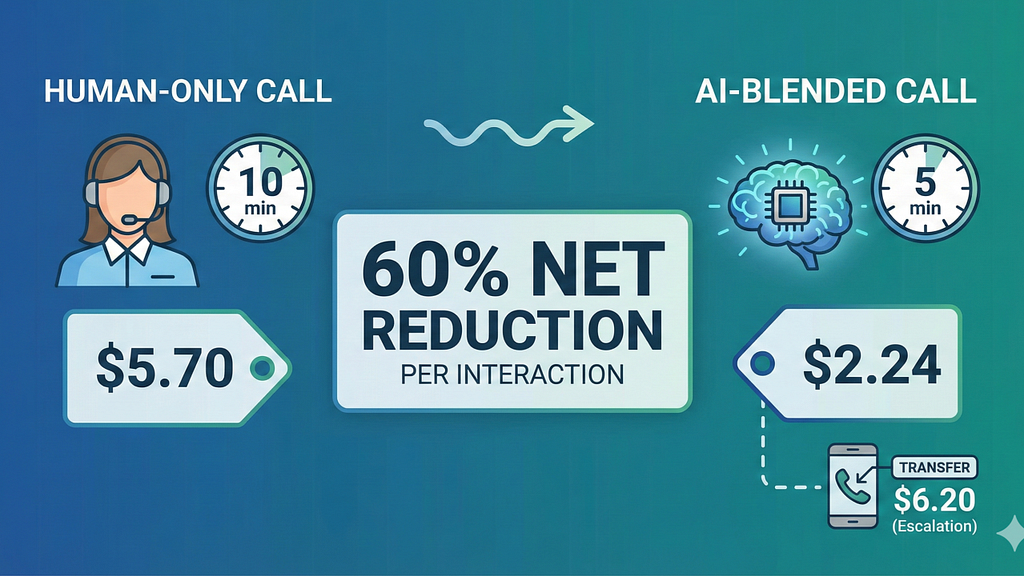
Phase 1: The Human Baseline (The $5.70 Call)
Before calculating savings, we must establish the “to-be-beat” cost: the fully loaded expense of a human agent handling a routine Level 1 (L1) support call.
In most mid-sized contact centers, the direct hourly wage is only a fraction of the story. A “fully loaded” annual cost includes benefits, training, software licenses, management overhead, and facilities. For this analysis, we use a standard industry baseline of $50,000 per agent per year.
The Utilization Factor
Crucially, you cannot divide this cost by 2,080 working hours. Agents are not on calls 100% of the time. Between breaks, team meetings, training, and idle time, a realistic Agent Utilization Rate is roughly 70%. This aligns with industry standards where utilization often hovers between 60–70% to prevent burnout.
- Total Annual Minutes: 124,800 (52 weeks × 40 hours)
- Productive Minutes: 87,360 (at 70% utilization)
- Cost Per Productive Minute: $0.57
The Cost of a Single Interaction
For a standard 10-minute L1 inquiry — such as an order status check or password reset — the math is straightforward:
10 minutes x $0.57/minute = $5.70 per call
This figure is the “floor.” When factoring in After Call Work (ACW), which often adds 2–3 minutes per interaction, the real cost frequently rises to $7.00–$8.00. However, for a conservative business case, we will stick to the strict $5.70 baseline.
Phase 2: The AI Cost Structure
AI agents operate on a fundamentally different financial model. Instead of a fixed salary, they typically use a usage-based model (e.g., cost per runtime minute) and offer significant efficiency gains.
The Efficiency Dividend
Unlike humans, AI agents do not “swivel chair” between multiple dashboards or type notes manually. They retrieve data instantly and log interactions automatically. This allows an AI to handle a call that typically takes a human 10 minutes in roughly 5 minutes — a 50% speed improvement.
- AI Runtime Cost: ~$0.25 per minute
- AI Call Duration: 5 minutes
- Total AI Call Cost: $1.25
If we stopped here, the ROI would be staggering: a 78% cost reduction on every interaction ($5.70 vs. $1.25). However, a robust business case must account for the reality of operations: not every call goes perfectly.
Phase 3: The “Honest” Model (Accounting for Reality)
To ensure your financial projections hold up against scrutiny, you must introduce a Containment Rate variable. This measures the percentage of calls the AI resolves fully without human intervention. Industry benchmarks for well-tuned voice agents suggest a containment rate of 65%–80%.
We must therefore calculate the Weighted Average Cost of an AI-led call, accounting for the “Escalation Penalty” when a call fails and is transferred to a human.
The “Blended” Cost Calculation:
- Success Scenario (80% of calls): The AI handles the call fully.
- Escalation Scenario (20% of calls): The AI attempts to help ($0.50 triage cost) but eventually transfers to a human ($5.70).
Real-World Unit Cost:
(80% x $1.25) + (20% x $6.20) = $2.24 per call
Even after factoring in a 20% failure rate, the economics remain compelling. The cost drops from $5.70 (human only) to $2.24 (AI blended) — a 60% net reduction on every L1 interaction.
Phase 4: Scaling the Impact
Applying this unit saving to a mid-sized contact center demonstrates how quickly small savings compound into strategic capital.
Scenario: A 20-Agent Contact Center
- Daily Call Volume: 750 calls
- AI-Eligible Volume (L1): 70% (525 calls/day)
- Net Savings Per Call: $3.46 ($5.70 — $2.24)
Financial Impact:
- Daily Savings: $1,816
- Annual Operational Savings: ~$479,000
Even after deducting a one-time implementation fee of $50,000 and an estimated annual maintenance budget of $20,000 for prompt tuning and QA, the Year 1 Net Savings exceed $400,000. The payback period on the initial investment is less than two months.
Proof of Concept: The Calculator in Action
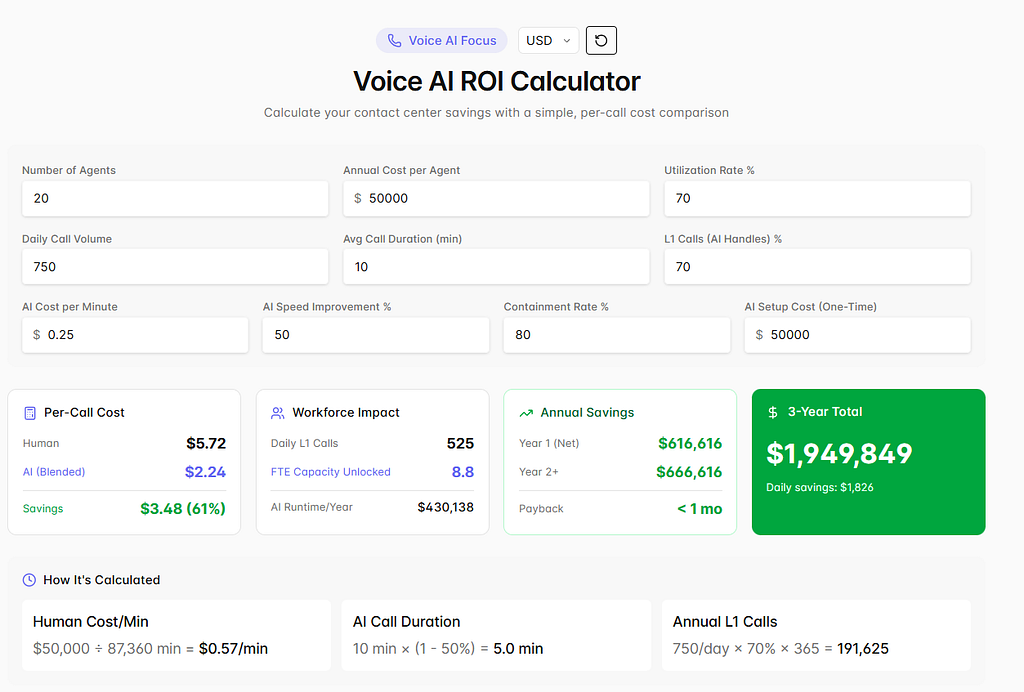
Above: We ran the scenario from this article through our own ROI calculator. By inputting a realistic 80% containment rate, the tool confirms a blended cost of $2.24 per call — resulting in over $600k in net annual savings for a 365-day operation.
Phase 5: Strategic Value — From Cost Center to Revenue Generator
The most profound impact of this ROI calculation is not the money saved, but the capacity created.
Redirecting 525 routine calls to AI is equivalent to unlocking the capacity of 16 full-time agents. In a traditional model, this capacity is lost to repetitive tasks. In an AI-augmented model, it can be redeployed.
If you redirect just 5 of those agents to proactive customer success or outbound sales:
- Activity: 5 agents × 20 outbound calls/day = 100 conversations.
- Revenue: At a 5% conversion rate and $100 value, this generates $132,000 in new annual revenue.
Conclusion
The ROI of AI is not a speculative future promise; it is a mathematical certainty grounded in unit economics.
By reducing the cost of L1 interactions from $5.70 to $2.24, you can fund your own transformation, improve customer satisfaction through lower wait times, and elevate your human talent to the complex, empathetic work they were hired to do.
The question is no longer “can we afford AI?”, but rather, “can we afford to keep paying $5.70 for a $1.25 task?”
Your Turn: Get Your Exact Numbers
The scenario above shows a $400k+ opportunity using industry averages. But your contact center isn’t “average.”
Don’t rely on generic math. We have built an interactive tool that uses this exact “honest ROI” framework.
[Click here to use our free AI Voice Agent ROI Calculator]
Plug in your actual agent salaries, call volumes, and utilization rates to get a personalized, defensible business case in under two minutes.
The Honest ROI of AI Voice Agents: A Unit Economics Guide was originally published in AI for Business Academy on Medium, where people are continuing the conversation by highlighting and responding to this story.