The operating model behind AI-first customer service
Better, faster, cheaper
Cost reduction is the small win. The big win is capacity: 24/7, multilingual, consistent service that frees humans for judgment-heavy work.
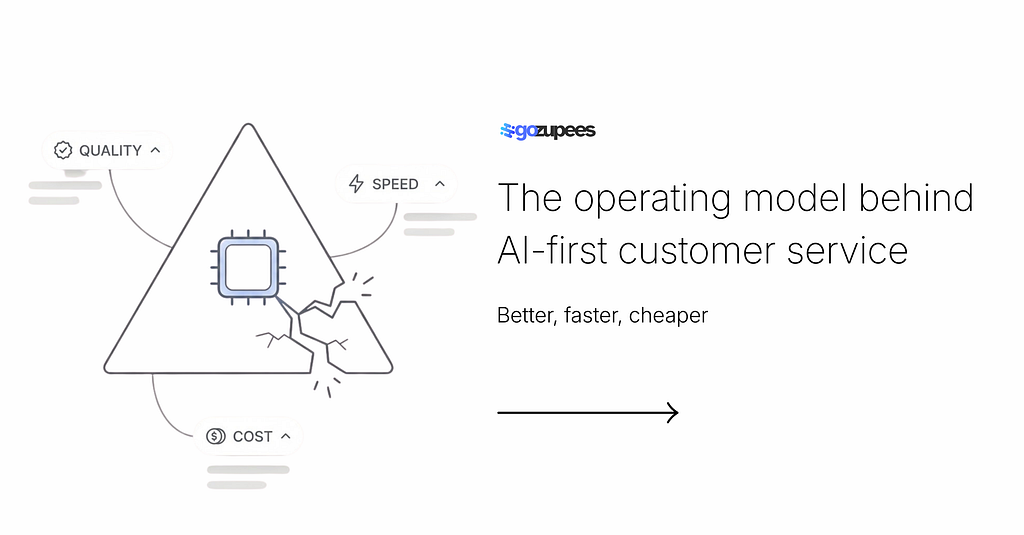
Customer service has lived under the same constraint as every other operational function: you can optimize for quality, speed, or cost — pick two.
If you wanted “world-class,” you staffed heavily. If you wanted “cheap,” you accepted delays and inconsistency. If you wanted “fast,” you either burned out your team or you lowered the bar.
That trade-off is collapsing. Not because AI is a cheaper agent, but because AI changes the underlying economics of service delivery: the marginal cost of handling demand, the cost of being wrong, and the organizational design required to earn trust at scale.
Most AI-support content stays at the surface: automate FAQs, reduce headcount growth, improve response times. Those are outcomes, not the shift. The shift is that service can increasingly scale like software — while humans focus on the work that actually creates loyalty, retention, and revenue.
The hidden economics leaders miss: service cost isn’t “responses,” it’s unresolved states
The visible cost of support is labor. The dominant cost is resolution.
Most support work isn’t answering. It’s reconstructing context: what happened, what the customer tried, what they’re entitled to, what was promised previously, whether this is a known incident, whether the “real” issue sits upstream of the question being asked.
That context work is expensive because it’s fragmented across tools and teams. It’s expensive because it’s repeated — again and again — across channels. And it’s expensive because when context is missing, customers come back. Repeat contacts, escalations, credits, refunds, and churn risk are not “edge effects.” They’re the bill you pay for unresolved states.
A useful way to think about support economics is this:
You don’t pay for tickets. You pay for problems that persist.
Why “deflection” often makes the business worse, not better
When volume rises, the standard playbook is to protect margins by adding friction: longer waits, harder-to-reach humans, heavier deflection.
It can look efficient in reporting. But strategically, it’s often expensive.
Because cost doesn’t disappear when you make service harder to access. It just changes form. Customers retry through another channel. They escalate. They arrive angrier. They cancel. They tell others. Support becomes slower and more adversarial, and the organization starts spending human time managing frustration instead of fixing issues.
Bad service doesn’t stay inside support. It becomes a growth problem.
What AI actually changes: it makes context cheap
AI’s biggest economic advantage isn’t that it can type responses. It’s that it can collapse the expensive part of service: context reconstruction.
Done properly, AI can read the entire interaction history instantly, summarize the state, pull the relevant policy, and ask the right clarifying questions in the right order. It can apply policy consistently, translate in real time, and keep the interaction coherent across channels.
This changes the cost curve in a way headcount never could:
- A portion of demand can be handled with near-zero marginal cost.
- The remaining human work becomes higher judgment and higher leverage.
- Speed and consistency reduce downstream costs like recontacts and escalations.
This is where “better, faster, cheaper” stops being a slogan and becomes an economic shift. In the old world, quality and speed usually raised cost. In the new world, speed and consistency can reduce total cost — if you don’t destroy trust in the process.
The constraint shifts: cost-to-handle drops, but cost of error becomes dominant
AI changes the economics, but it also changes the primary risk.
When AI is wrong, the cost isn’t “one bad response.” It’s second-order damage: repeat contacts, escalations, refunds, compliance exposure, and customers who conclude you’re hiding behind automation.
That creates what we call trust debt — hidden liability that compounds over time. On paper, your automation rate can look great. In reality, humans end up undoing damage, customers lose confidence faster, and churn risk rises.
This is why “deploy AI” is not the hard part. The hard part is designing an operating model where AI can move fast without guessing, and where escalation is a strength — not an apology.
The two failure modes that kill AI-first support
Most teams fail in one of two directions.
Some overreach. They give AI autonomy too broadly, it hallucinates or misapplies policy, customers stop trusting it, and escalation volume turns toxic. The system becomes brittle and political: nobody wants to be responsible for what the AI said.
Others underreach. They keep AI trapped in superficial FAQ deflection while humans remain stuck doing Tier 1 forever. Nothing meaningful changes, leadership loses patience, and the organization concludes “AI didn’t work.”
The model wasn’t the limiting factor in either case. The operating design was.
The GoZupees operating model: resolve what you can, compress what you can’t
The “AI vs humans” debate is a distraction. The real question is: which work belongs where — and why.
In practice, service demand falls into three economic shapes:
Simple and informational: the customer needs clarity, not investigation.
Simple but customer-specific: the steps are known, but the answer depends on entitlements, account state, history, or permissions.
Genuinely complex: ambiguity, broken states, multi-system diagnosis, exceptions, or high-risk situations.
AI should fully resolve the first category immediately. It should resolve the second category only when it has governed, auditable access to the right customer context. And for the third category, AI should not pretend to “handle the customer.” It should handle the context: summarize the situation, surface likely causes, retrieve relevant knowledge, draft next steps, and hand a human a clean, structured escalation.
That’s the model: AI resolves what it knows, and accelerates what it doesn’t.
The goal isn’t maximum automation. The goal is minimum total cost of service with maximum trust.
Why AI forces maturity: it automates your most explicit process, not your best one
Humans can compensate for ambiguity. AI can’t.
If your policies are inconsistent, AI will expose it. If your knowledge is outdated, AI will amplify it. If your entitlements are unclear, AI will either over-restrict and frustrate customers — or overstep and create risk.
This is why AI adoption is rarely “a support project.” It’s a forcing function for operational maturity across policy, product, billing, and data access. You cannot scale trust on top of ambiguity.
That’s also why the right first investment isn’t a bot. It’s a service production system: clear rules, permissioning, instrumentation, and feedback loops that improve the source of truth continuously.
What “good” looks like: a service production system, not a chatbot
Teams get into trouble when they treat AI as a feature rollout: turn it on, watch the dashboard, patch issues as they appear.
AI works in serious environments when it’s run like a controlled production system.
You start with baseline clarity: top contact drivers, where time is actually spent, what portion of volume is failure demand, where knowledge is missing, where policy ambiguity creates repeat contacts.
Then you introduce AI first where it creates leverage without risking trust: summarization, drafting, translation, knowledge retrieval, tagging, routing, internal assist.
Then you expand into bounded resolution categories with strict scope control and clean escalation behavior.
Over time, you build a system that’s confident when it knows and graceful when it doesn’t — while continuously reducing failure demand by feeding insights back into product and policy.
The work changes — so the measurement must change too
As AI absorbs the simple work, the remaining human work gets harder. Handle time can rise. Ticket closures can drop. Back-and-forth can increase because issues are genuinely complex.
If you keep scoring teams on old productivity metrics, you punish the work you actually want — and the transformation stalls.
The scorecard has to shift toward outcomes: resolution integrity, repeat-contact reduction, customer effort, and escalation quality (did the human receive full context, or did the customer restart from zero?).
When the system is designed correctly, support stops being measured by how quickly it clears a queue and starts being measured by how reliably it restores certainty.
The real promise of “better, faster, cheaper” is strategic
Yes, AI can reduce cost-to-serve. But the bigger unlock is this:
Smaller teams can deliver service capabilities that used to require massive scale — immediate responses, 24/7 coverage, multilingual support, consistent policy execution — without building an organization that grows linearly forever.
And that frees humans to do the work that actually drives retention and revenue: complex diagnosis, relationship-sensitive escalation, consultative guidance, and proactive interventions that prevent problems before they arrive.
AI-first customer service isn’t a chatbot story. It’s a business capability story.
The organizations that win won’t be the ones with the most automation. They’ll be the ones that build the most reliable service system around AI — and use it to earn trust at scale.
The operating model behind AI-first customer service was originally published in AI for Business Academy on Medium, where people are continuing the conversation by highlighting and responding to this story.