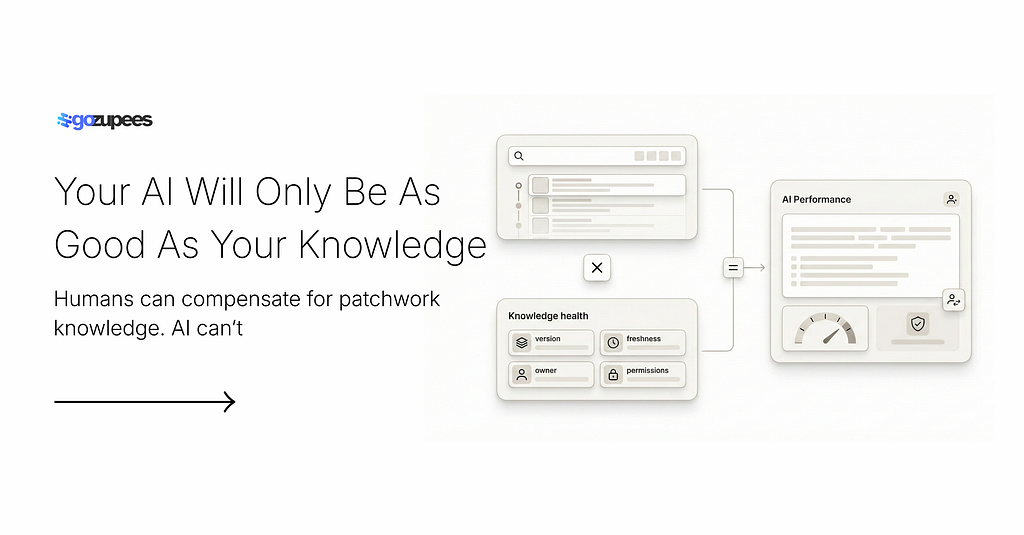
Your AI Will Only Be As Good As Your Knowledge
GZP Reality Check
Humans can compensate for patchwork knowledge. AI can’t — it will confidently repeat whatever it finds, including contradictions, policy drift, and stale workarounds.
There’s a hard truth most support organizations already feel:
If the external help center is “fine,” internal knowledge is probably a patchwork of Slack threads, half-updated docs, and tribal memory.
That wasn’t fatal in a human-only world. People are remarkably good at compensating for messy information. They ask someone who’s been around. They remember how the last escalation went. They infer what “should” be true and route around gaps.
AI doesn’t route around gaps.
AI is not a mind reader. It is a pattern engine paired with retrieval. The quality of its output is constrained by the quality of the truth it can access — public truth and internal operating truth: playbooks, SOPs, policy docs, product notes, known issues, release notes, escalation criteria, entitlement rules, and the “how we actually do it” guidance that rarely makes it into a clean article.
At GoZupees, we use a simple equation because it forces focus:
AI performance = retrieval quality × knowledge quality
Most teams fixate on the AI. The highest leverage is the knowledge.
Because the moment you deploy an AI agent or an agent copilot, internal knowledge stops being “nice to have.” It becomes an operational dependency. If that dependency is wrong, unclear, scattered, or outdated, the failure mode isn’t just inefficiency — it’s risk:
- confident but incorrect customer guidance
- inconsistent policy enforcement across channels
- entitlement and pricing mistakes (“who gets what, today”)
- compliance and privacy missteps
- escalations driven by missing or conflicting guidance
- loss of trust when customers get different answers from different paths
This is why “knowledge readiness” is not a documentation project. It’s reliability work.
And the goal isn’t to boil the ocean. The goal is to build a system where truth is maintainable.
Why Internal Knowledge Matters More Than People Expect
External content is designed to be readable by customers. Internal content is designed to help teams operate. It’s more conditional, more specific, and changes more often.
And it contains the answers to the moments that define support quality:
- What happens when the customer is technically right but policy says no?
- When do we escalate, to whom, and what does “ready to escalate” mean?
- What’s the current workaround for the issue we haven’t fixed yet?
- Which plan includes this feature right now?
- What do we say when legal/compliance constraints block a straightforward answer?
These are the moments where customers judge competence. They’re also where AI is most likely to stumble if internal truth is fuzzy.
Internal knowledge is where the operating truth lives. If that truth isn’t maintained, AI will amplify the mess at scale.
The Internal Knowledge Problem Isn’t Writing. It’s Ownership.
Most organizations don’t fail at internal knowledge because people can’t write.
They fail because truth doesn’t have clear owners, standards, and lifecycle rules.
The same failure modes show up again and again:
Conflicting truths
Two docs describe the same process differently because one was updated after a tooling change and the other wasn’t.
Hidden truth
The “real process” lives in a Slack message, a personal note, or someone’s memory.
Unfindable truth
The doc exists, but no one can locate it during a live customer interaction.
Unusable truth
It’s written for the author, not the reader — long, jargon-heavy, missing decision points and exceptions.
Expired truth
It was correct once, but nobody was accountable for keeping it correct.
AI copilots and agents make these failures visible fast. Not because they’re “bad,” but because they’re literal: they surface contradictions, retrieve stale advice, and present ambiguity as certainty unless you explicitly constrain it.
So the goal isn’t “write more.” The goal is make truth maintainable.
A Practical Starting Point: The Internal Knowledge Readiness Scorecard
Before changing tools or starting migrations, assess where you are. Not with a six-week audit — with a fast scorecard you can run in a few hours.
Pick 30–50 high-impact internal docs (the ones agents search every day) and score each 1–5:
-
Accuracy
Is it correct today? Not “mostly right.” Today. -
Freshness
Is there a named owner and a “last reviewed” date? If not, it’s already decaying. -
Clarity
Could a new hire follow it without a buddy system? If not, AI will struggle too. -
Findability
Can someone locate it in under 30 seconds during a live ticket? -
Coverage
Does it answer the real question, including edge cases and decision branches? -
Consistency
Does it match policy language, pricing, product behavior, and approved customer language across channels? -
Safety & boundaries
Does it clearly mark what must not be said or done (privacy, security, legal), and when to escalate?
This scorecard does two things: it gives you a baseline and it reveals the highest-leverage fixes. Most teams discover the same thing: a small percentage of docs drive a huge percentage of support outcomes.
Start there.
Step 1: Map the “Truth Layer” Without Forcing a Single Tool
Teams get stuck trying to pick the perfect knowledge platform. That’s a trap.
The first move is not migrating everything. It’s mapping where truth currently lives and deciding what type of truth belongs where.
A pragmatic structure that works in real organizations:
- Customer-facing truth (help center, public docs)
- Agent-facing truth (internal playbooks, troubleshooting, macro rationale)
- Engineering truth (runbooks, incident notes, known issues, operational context)
- Policy truth (refund rules, compliance requirements, identity verification)
- Commercial truth (contract constraints, exceptions, plan differences)
AI works best when you can connect these truths without duplicating them. Duplication creates drift. Drift creates contradictory answers. Contradictory answers become customer-visible.
The goal is not “one tool to rule them all.” It’s a clear map of what is authoritative for what — and a reliable way to reference it.
Step 2: Rewrite Knowledge in Decision Format, Not Essay Format
Internal knowledge fails when it reads like a narrative.
What humans need in the moment — and what AI retrieves most reliably — is structured, decision-ready content:
- clear triggers (“If the customer reports X…”)
- clear checks (“Verify Y in tool Z…”)
- clear actions (“Do A, then B…”)
- clear boundaries (“Do not do C unless…”)
- clear escalation criteria (“Escalate when…”)
- a clear definition of resolved (“Resolved means…”)
A simple internal doc format that consistently works:
Title: “What to do when…” (make it searchable)
When to use this: 2–3 bullets describing the situation
Fast diagnosis: what to check first (tools + links)
Resolution paths: Path A / Path B / Path C
Customer language: approved wording + what not to say
Escalate if: explicit criteria + who to route to + required context
Owner + last reviewed: name + date
This isn’t bureaucracy. It’s throughput. It reduces agent effort and improves AI reliability because ambiguity drops.
Step 3: Treat Knowledge Like Product Infrastructure
The mindset shift that separates “we have docs” from “we have a knowledge system” is simple:
Knowledge needs an operating model.
At minimum, enterprise-grade knowledge management requires:
Clear ownership
Every doc needs an accountable owner. Not “Support” broadly — someone who is responsible for correctness. Ownership can be distributed, but it must be explicit.
Review cadence
Some knowledge decays quickly (policies, pricing, known issues). Other knowledge decays more slowly. But nothing is timeless. If there is no review mechanism, drift is guaranteed.
Change signals
Truth must update when product changes, policies change, tooling changes, or incidents occur. The teams who ship change must trigger knowledge updates — otherwise support absorbs the cost of drift forever.
A practical tactic: treat knowledge updates like lightweight PRs — small, reviewable, trackable changes — rather than massive rewrites nobody finishes.
Instrumentation
If you can’t see what’s used, you can’t prioritize. Track:
- top searches (what people can’t find)
- top viewed docs (what drives outcomes)
- “no result” searches (what’s missing)
- escalations caused by unclear guidance (what’s failing)
- areas where policy variance shows up across channels (where trust erodes)
AI copilots make this easier because they surface gaps continuously: low-confidence answers, repeated handoffs, and recurring questions are signals that truth is missing or unclear.
Step 4: Design for AI Consumption Without Writing “For AI”
A common fear is: “Are we going to turn our docs into robot content?”
You don’t need to. You just need to remove what confuses retrieval and interpretation:
- eliminate duplicates (one truth, many links)
- standardize naming (feature names, plan names, tool names)
- pull caveats forward (don’t bury exceptions in paragraphs)
- write explicit constraints (“Only for X segment,” “Not available in Y region”)
- add metadata (owner, last reviewed, applicable segments)
- prefer examples over abstractions (“Here’s what to say when…”)
This is clarity work. Humans benefit first. AI benefits automatically.
Step 5: Don’t Ignore Governance and Permissions
Internal knowledge is powerful because it contains operational truth. It may also touch sensitive topics: security steps, privacy handling, financial exceptions, legal constraints, identity verification.
If you’re preparing for AI, you need a lightweight classification scheme and clear access boundaries. Not to slow things down — but to prevent accidental leakage and to build internal trust.
When teams believe AI will blur boundaries, adoption fails. Permissions and guardrails are not bureaucracy. They’re adoption infrastructure.
The Compounding Return
The first ROI isn’t flashy. It’s felt:
- fewer repeated Slack questions
- faster onboarding
- escalations ship with complete context
- policy enforcement becomes consistent
- customer answers become more confident — not just faster
Then automation compounds it:
- copilots retrieve correct answers more reliably
- AI agents resolve more because truth is available
- analytics identify what knowledge is missing
- knowledge becomes a living system, not a museum
This is one of the few transformation efforts where every improvement benefits humans and automation simultaneously.
The Bottom Line
AI won’t fix messy knowledge. It will scale it.
If you want AI-first customer service to be trustworthy, consistent, and genuinely helpful, internal knowledge has to graduate from “support collateral” to core infrastructure: maintained, owned, findable, and safe.
That shift — building a maintainable truth layer — is what separates teams that deploy AI from teams that actually benefit from it.
Your AI Will Only Be As Good As Your Knowledge was originally published in AI for Business Academy on Medium, where people are continuing the conversation by highlighting and responding to this story.